November 2007

Fun With our Meebo Widget and the Library Catalog

by David Lee King on November 30, 2007

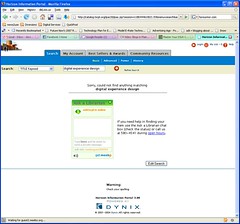
meebo in the catalogUpdate: I’m getting some questions on how we did this, so… We have a Horizon system – look for the searchinput.xsl page in your XSL folder. Then find the appropriate chunk of code where the “nothing found” message and table appears, and add the meebome widget there.

And if you have more questions, feel free to email me (davidleeking at gmail dot com) – and I’ll put you in touch with our Web Administrator.

*************

I was reading Helene’s post about online chat, and remembered I had wanted to try something in my library’s catalog… and we just went live with it.

What did we do? We added a Meebo widget to unsuccessful keyword searches in our library catalog. This way, when a customer searches our catalog and doesn’t find anything, they can contact us via IM and ask for help (we also display our phone number if they want to call).

SO – should be interesting to see what we get from this (since we just turned it on maybe 15 minutes ago). If nothing else, it’s a solid attempt at “humanizing” the OPAC!

107 comments

Actual Work Using Facebook

by David Lee King on November 29, 2007

Just a small aside… but I’ve been doing real live work the last two days using facebook (go friend me – David Lee King at facebook)!

Michael Porter, my writing buddy, is to blame for some of it… :-) We write the Internet Spotlight column in Public Libraries Magazine together, and he posted a question to his facebook friends. The plan is to incorporate some of those responses, some he’d gotten via email, etc into a cool article [status: article almost done, and IS cool].

So part of the work was copying/pasting quotes and contacting the quotees to get job titles, etc. Whew!

But that has spawned a whole host of facebook emailing back and forth, getting new information, thinking “out loud” via facebook email about library innovation in other areas, and even making a few new facebook friends.

So – real live library work in facebook. It can be done! Anyone else want to pony up? How do you use facebook to do actual work (or do you?).

14 comments

Wanting Your Opinions about Blog Comments and City Attorneys

by David Lee King on November 29, 2007

A new Facebook friend just asked me a question, and I thought I’d share it with y’all – in hopes of garnering him some more input, or “ammunition” if you will…

Here’s the deal:

“Maybe you can answer a question that our City attorney needs clarified?
She seems to think that if we [a public library] have a blog we can’t restrict commenting
(at all) because it’s a public forum (the City recently even got rid of
the Mayor’s bulletin board because of this). From my own Internet
research it seems that this is the case from a legal standpoint. How
are other libraries dealing with this? If this is the case it seems
that it’s only a matter of time before some library gets sued over this.”

“Do
you know of any libraries getting sued for removing comments, or where
to find any pro blog justification for libraries from a legal
standpoint? Blogging is obviously a good thing for a library to do, but
the City is deathly afraid of lawsuits… Even the chance of a lawsuit
and they won’t go out on a limb to disrupt the homeostasis. My
municipality is very conservative in this regard.”

As an aside – good the for the city attorney for recognizing blog comments as a form of public forum (because it is).

Now, obviously I’m no lawyer, but I told my fine facebook friend that as long as the library has a policy in place that covers how the library handles comments, they should be covered (certainly anyone CAN sue… but probably not successfully?). And that policy is probably already there in some form of patron behavior clause.

And – I’m pretty certain there are some libraries that really DON”T remove comments – they show the bad AND the good, and just filter a short list of “naughty” words. So that might meet the city attorney’s requirement, too.

So… what do you think? How does your library handle website/blog/myspace/facebook/youtube/etc comments? Do you moderate? Do you block words? Do you remove the nasty comments altogether? And do you have a policy or guideline in place for commenting?

24 comments

How to Carve a Thanksgiving Turkey (way off-topic)

by David Lee King on November 21, 2007

This Thanksgiving, I have the honors of carving “The Bird” (a 21 pounder, to be exact – we’ve got like 28 people descending upon us tomorrow!). Unfortunately, I have no idea how to do this. Really! I mean, I’ve certainly tackled turkeys before… but my handiwork usually ends up resembling more of a hack-fest than something that would sit on Martha Stewart’s table.

So I thought to myself “hmm, self. I wonder if there are any helpful turkey tips out there in web 2.0 land?” And guess what??!?!!?? There are. Since you might also be as thanksgiving-turkey-carving challenged as me, I thought I’d pass along the tasty turkey tutorials to you, too:

“But wait, David! I’m a visual learner – what about me?” OK – how’s about some YouTube videos?

And finally, I leave you with It’s JerryTime – The Gobbler. Everyone (in the US anyway) – enjoy Thanksgiving!

7 comments

Ignoring our Digital Community

by David Lee King on November 20, 2007

Lately, I’ve been hearing librarians say some interesting things about incorporating emerging online trends into their already hectic work lives. They’ll say “wow, this is cool” when I give a presentation – but when implementation time arrives – when these busy people actually need to start incorporating some of these new things into their work day, here’s what I sometimes hear (warning – simulations of real stuff I hear):

“we don’t have time to write blog posts – we’re busy serving customers” or “I’m extremely busy answering real patron questions all day long, so I don’t have time left to [fill in the blank with a 2.0 tool]“

I understand what they’re saying. It’s difficult to believe this new-fangled, 2.0-ish stuff is relevant when you are sitting at a busy service desk with a line 20 people deep, or when you have waiting lists for computer use. Library 2.0 is about building community? Visit a public library branch any day to see community building in action. Attend a program, join the bookclub, participate in an adult literacy or ESL program as a volunteer tutor or learner. That’s community building. Sometimes, emerging 2.0 tools and services seem to get in the way of all this busy, real-time activity already taking place.

Ok, wait a sec. This is davidleeking dot com we’re reading, right?

Yep… I see a small problem in the stuff I just said. Most of our library communities have a quickly-growing number of library customers that are actively participating in the emerging web – they are already creating content, participating, and interacting – with each other and with the companies and products they use. They are your library’s digital community.

The problem? We don’t have anything for our library’s digital community to do! OCLC‘s recent report, Sharing, Privacy and Trust in Our Networked World says this about our physical libraries: “Offline, libraries are vibrant social spaces. They are hubs of community activities and provide a venue for open exchange and dialogue” (8-5). But online? How many libraries can say they provide “vibrant social spaces,” hubs of community activity” or “a venue for open exchange and dialogue” in our digital spaces? Not too many.

Why is this? I think we’re simply not focusing on that growing digital community. Yes, we ARE focusing on customers (that’s a good thing)… but many of us are only focusing on our library’s regular in-house customers (that’s a bad thing). It’s quite possible that by focusing primarily on library customers who visit the physical library, we are ignoring our growing digital population.

Huh?
Let me use my library as an example. We certainly get our fair share of traditional walk-in customers – our parking lot is ALWAYS FULL. But we also have a huge number of digital customers. Remember what we do with holds? We mail them out – you never have to physically visit our library to check out a book (cool, huh?).

Those items our customers are putting on hold come from our digital community – most likely customers who used our online library catalog from home or work. That’s just one example of living, breathing members of our digital community using our digital library. And they are a growing digital community. What else do we offer them? Thankfully in my library’s case, quite a lot currently (with more to come next year).

Let’s develop this a little further by perusing OCLC’s report a little more. OCLC provides some amazing insight into our growing digital communities:

  • “The vast majority (89%) of the 6,163 general public respondents have been using the Internet for four years or more” (page 7-1) [update – Michelle reminded me that OCLC surveyed online users… the Pew Internet & American Life Project’s research shows that 73% of the US are Internet users, for what it’s worth)
  • “The majority of the online population surveyed have moved from “digital immigrant” status to fully naturalized digital citizens. Nearly two-thirds of the general public respondents over the age of 50 have been online for seven years or more, and nearly a third have been using the Internet for more than 10 years” (page 7-1)
  • “The Web community has migrated from using the Internet to building it.” (7-1)

Did you hear that? Most A majority of our library customers have used the web for at least 4 years. And most of those customers (read the report for the stats) have grown beyond simple clicking and surfing… they are interacting, creating, and participating… at other websites.

The gist of the report is this – the web has moved on, and libraries need to catch up. “To entice users to the online library, libraries must expand their social activities, allowing users to easily share and create content and collaborate with others. They must build a high-value presence on the Web, a strong enough brand to compete…” (8-5).

First steps? Stop ignoring your library’s rapidly-growing digital community. They might not be current users of your physical library – how can you reach them? What do you have to offer them? Can you offer them something that would keep them coming back for more?

I think so.

28 comments

blog readability level

by David Lee King on November 15, 2007

cash advance

How funny – my blog’s reading level (wouldn’t my professors be proud?)…. found here.

19 comments

Some Thoughts and Quotes about Authenticity

by David Lee King on November 15, 2007

I’m reading Authenticity: What Consumers Really Want, by James H. Gilmore and B. Joseph Pine III (same guys that wrote The Experience Economy). I love this type of book – the focus is still on Pine and Gilmore’s favorite topic, that of the experience economy. But this time, they have narrowed that focus a bit, to how those experiences can be perceived as authentic experiences. I’ll be sharing thoughts and random quotes from the book as I read it.

The first quote comes from the preface of all places! “..too many [businesses] have latched onto that single word – experience – without changing core business practices. Too many companies say they’re offering ‘experiences’ without actually staging experiences” (page xii).

That actually answers a question I’ve had as I have started to check out some of these businesses that claim to offer an experience of some sort. For example, I’ve visited Cold Stone Creamery twice now. They have amazing ice cream (and their watermelon sherbet is to die for – it’s that good)… but the experience they tout? Not so much.

What have I actually seen in my two visits? Teenaged staff paying next to no attention to me while quickly making my ice cream concoction, not making a big deal of the cold stone marble mixing board at all, and quickly hustling me out of the way – even when there’s not a crowd. What gives? Well, apart from me smelling bad or something that day, somehow the corporate message of the Ultimate Ice Cream Experience wasn’t translated down to the Cold Stone Creamery workers in Topeka, Kansas. Did those employees receive the “hey, this is an experience we’re serving” message during initial training but decided against the practice? Were they even trained in imparting that staged experience at all? I have no idea. But in this case, the actual delivered experience did not match the experience the corporate office wants to provide.

Libraries and other organizations sometimes do the same thing – the experience we want to provide often doesn’t match what we actually dole out daily. Think about it for a sec – does your mission statement match what happens in your building on a daily basis? And… does “what happens in your building” match what goes on on your website? For example, some libraries think of themselves as community gathering places. But then when the community actually gathers, they’re told to be quiet, to turn their cell phones off, and to please drink that coffee outside the building. Or, the staff and the physical building both do a great job of offering a physical community gathering place, but doesn’t do a good job of offering a digital community gathering place. Their digital community tries to gather, but quickly finds no place to gather at all, because the website is no more than an electronic brochure with links and a catalog database – so they gather elsewhere (ebay forums, yahoo groups, myspace). They “have left the building.”

If this describes your library, maybe you need to take a step back… step back and give some hard thought to:

  • what you want the end result to be
  • even better, ask your customers what THEY want THEIR end result to be
  • then create a strategic plan, mission statement, vision, etc that focuses on reaching that desired end result
  • teach your staff how to create, mold, or otherwise deliver that end result (or at least work towards it) physically AND digitally
  • redesign that website so it does the same thing – so it focuses on providing the desired end result

If we plan on offering experiences, let’s start changing those core business practices so we can actually deliver engaging experiences to our customers.

11 comments

Salt Lake City Public Library Presentations

by David Lee King on November 13, 2007

Salt lake city public library Yesterday, I spoke at Salt Lake City Public Library’s staff day. I actually gave three presentations – one keynote and two breakout sessions… all three were extremely fun talks!

Salt Lake’s staff day theme this year was “Transform.. Adapt… Grow.” Transformation is a strong theme with them right now – for example, take a peek at what one needs to submit for their current Library Director opening: “The package should include a paper resume and directions to your digital presence, blog, or social networking Web site.” Wow.

Anyway, here are some links to the two presentations I gave:

And as promised, here are the links to all the websites I mentioned in the keynote (in the order they appeared, I think):

10 comments

Big Juicy Twitter Guide

by David Lee King on November 7, 2007

Want to find out more about twitter, but don’t like the screencasts David Free and I created? Well then… you’re in luck! Go read The Big Juicy Twitter Guide, by Caroline Middlebrook. She covers everything – from what is twitter, to twitter tools, to multiplying your twitter audience.

4 comments

Valuing Users by Allowing Comments

by David Lee King on November 5, 2007

Casey Bisson said this during his Internet Librarian 2007 presentation: “sites that allow comments value their users.” When he said that, my mind started making connections… what a great way to illustrate why the ability to comment is such an amazing thing to include on a website! So riffing off that quote, here are some thoughts (and I encourage you to continue riffing and see what more you come up with – if it rocks, I’ll add it to my list).

When you allow comments by users/customers/patrons, you are valuing them:

  • You are validating their voices: By offering a way to let customers comment, the library becomes an enabler for conversation. You are saying the library cares about customers, and the library wants to hear from customers. And any voice or thought is valid – praise and criticism, complaints and suggestions.
  • You are saying you want to listen: no cold shoulders! How many companies actually want to hear you? Have you ever hunted for hours for a 1-800 number for eBay or gone through their complaint/get-your-money-back process? I have – and I came away with the feeling that eBay, cool business that it is, didn’t really want to listen, and was more interested in getting my money than in helping me have a successful selling/buying experience.
  • You are asking them to participate: opening up the possibility to comment is a form of invitation to participate. It allows actual interaction with real, live people. it also sets up a type of digital town hall meeting where someone’s expressed opinion can be heard, discussed, debated, and distilled by others within earshot (ie., other readers)
  • Users can add value to website content: Libraries hire smart people. Your customers are ALSO smart people, and libraries are just starting to use those amazing customer brains to add to the value of library content. Some libraries do this by allowing customers to create book reviews. Others allow customers to comment on blog posts or on wiki pages. A few libraries allow customers to add relevant content and notes to local history projects (ie., seeing an old photo and telling others who is in the photo, etc).
  • You are valuing their time: In my eBay example above, I wasted a lot of time trying to find that 1-800 number. By allowing comments on most pages of a website, you are saving the time of your users. They no longer have to hunt for a single online comment box or find the “contact us” page to find the phone number. Instead, they can leave their comment or question right there, right then – in a place that makes sense (the page where the question or comment came up)
  • You are adding value to their words: By not hiding a customer’s words, thoughts, questions, or comments, you are getting more bang for the buck – you are adding value to the content on that page. Value is added by giving the customer a digital megaphone – since the comment fits contextually on the same page as the comment, and might even visually use the same colors and font sizes, you have just given the customer’s comment the same weight as the website content. Words that before the web might have been said in a private phone conversation or in a private letter now have been given the added benefit of reaching a much larger audience (potentially a global audience).
  • You are adding value to their experience: You improve the customer’s experience by allowing comments in as many places as possible. Steve Krug’s book says “don’t make me think” many times. When the customer has easy-to-reach comment boxes on every page of a blog or a website, they don’t have to think about website functionality or about how to find a way to contact the organization – that part is done. Instead, it frees the customer up to think about what’s REALLY on his/her mind. And that creates a positive experience for the user.

Again, some thoughts. Do you have any to add?

18 comments