Here’s my presentation from today’s Handheld Librarian III web conference. It was a fun talk, and a great conference – lots of good food for thought.
Enjoy!
social media | emerging trends | libraries
Here’s my presentation from today’s Handheld Librarian III web conference. It was a fun talk, and a great conference – lots of good food for thought.
Enjoy!
Check this out… John Ary, a guy who lives in Topeka, has been making videos talking about why he loves Topeka, KS. Some of his videos have helped with that Google Fiber project thing that many cities have hoped to be a part of.
In this video, John talks about loving a good deal … and shows off our library’s media dispenser in the process! He did a great job of it, too – it’s a professionally-done video … and a great advertisement for our library, in the process!
The coolest thing about this video? We didn’t ask him to make it. He just found something he loves about our library, and decided to share it. How cool is that?
ps – yes, we have a big, honkin, Mediabank media dispenser (yikes – for some odd reason, their website uses frames, so you can’t easily link to the actual product page. Hmm…). We keep popular movies and video games in it. Ours will hold about 3000 items, I think… made by Libramation. It took awhile to iron out details and get it to work right, but now it’s working well for us.
 A lot of people read, commented, and tweeted about my last post, Getting Permission. First off – thanks! It’s an important topic, and one with no easy answers.
More than one commenter asked a similar question – Emily Ford, at the cool In the Library with the Lead Pipe blog, sums it up nicely. She asks:
Do you have any tips about how to try to move forward and get permission and get things done in an organization that has its issues? How can we be proactive without having to leave our organizations to be able to do good things?
My answer to that? I want YOU to answer it! I’m guessing some of you have some great answers to Emily’s question – experiences, best practices, etc. Stuff that worked for you, ideas you read about but haven’t yet tried, etc.
My goal here is to answer Emily’s question … AND to create a list of useful ways to move forward and get permission when you have a less than stellar boss, a conservative organization, a traditional IT department, etc.
And if you want to tweet your answer, please use the hashtag #getpermission – could be a fun way to share.
So – how do YOU get permission?
 Last week, Emily Lloyd at Shelf Check (very funny librarian comic strip and a fine blog, too) posted What would you do if you didn’t need the approval of 15 committees? And mentioned me. Here’s what she said (make sure to read the whole post AND comment on it. It’s good):
“I think of what, for ex, David Lee King does for Topeka & Shawnee. David has lots of talent; David has lots of gear…but a lot of folks who work in libraries have lots of talent and lots of gear. What ultimately matters most, it seems to me, is lots of permission. David has that, I think–at least it looks like it from here–and most of us don’t. Many of us don’t need to be told or taught at conferences how to engage with patrons via social media, how to market our libraries via YouTube or Facebook, etc–we need our administrators to be told or taught that they should allow us to do so … You can’t seize the moment; you can’t seize the day; you’re lucky if you can seize the year. Old Spice/New Spice practically seized the nanosecond.”
She’s right – I DO have a boatload of permission. How do I get that permission? I don’t think there’s an easy answer to that, but I’ll try! Here’s what I do to get that permission:
But I’d be lying if I said that’s ALL that happens. The organization plays a big part in my permission, too:
Not getting that permission? Here’s what might be going on:
Something to think about – no, you can’t change administration. If you have a bad library director or bad managers, the only real way to change that is to find another job (or wait it out, if you’re extremely patient, I suppose). Sorry about that.
But did you notice? The other three points under “not getting that permission” are things you can change, or at least have a say in – even if you’re not a manager. Maybe your library doesn’t have a strategic plan – you can still set annual goals for your job with your supervisor, and start working on those things. You can focus on aligning your projects with the library’s strategic goals. And you can ask for permission.
OK – I’m sure I’m missing something here, but it’s a start!
Update – make sure to read the next post, Help Others Get Permission … and make a comment!
A couple of people have recently mentioned they like the quality of the sound in my videos, and have asked what microphones I use for videos and screencasts. Here’s what I’m using right now:
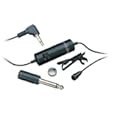 Audio-Technica ATR3350 lavalier
I usually plug this lavalier mic into my Sanyo Xacti videocamera. It’s cheap, it sounds fine, and it allows me to improve the sound of my videos. Did I mention it’s cheap (like $20 or so)? And for my Xacti anyway, it’s very easy to use – I just plug it into the viceocamera’s external mic input and forget about it – nothing else to mess with.
 Samson C01U USB Studio Condenser and the Blue Snowball
When I’m making a screencast, I usually plug one of these two mics into my laptop via a USB cable. I like the Samson better – it sounds better to my ears. Also, the Blue Snowball had an issue with Windows Vista (as in it didn’t work for me), so it hasn’t gotten as much use at work (my work laptop has Windows Vista loaded). I have used it without a hitch on my Mac laptop – it sounds great, and has a couple of different mic signal patterns that you’d use for different micing situations.
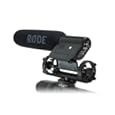
We have a semi-pro videocamera at work (the Canon GL 2). It has an ok mic built into it, but the RØDE mic is a fine shotgun mic. Plug it in, aim it at someone, and they’ll sound like they’re talking into the mic, even if you’re 10 feet away from them.
Tips on using these mics: