News Media

Tips for going on TV

by David Lee King on December 5, 2012

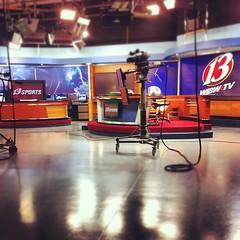
WIBW StudiosMy library is lucky – our local TV news station loves the library, and gives us a spot every Tuesday afternoon called “Library Tuesday.” The afternoon anchor does a quick 3-minute interview with someone from the library.
Once in a while, that someone is me. I’ve been able to talk about a website redesign, a new library catalog, and our Podcamp Topeka annual conference.

If you combine that with also being on regional TV news a couple of times for my new book Face2Face, I can honestly say I’ve been on TV more than the average librarian :-)

Between being prepped by the library’s marketing director, by reading a couple of articles, and just by doing it, I have picked up a few pointers along the way that I’d like to share with you.

So – here are some Tips for being interviewed on TV:

Looking good on TV:

  • Dress the part. Check out what the interviewer usually wears (by watching a clip online or by watching the day before your interview), and dress in a similar style. Stick to plain colors – no loud stripes or big shiny jewelry.
  • Look interested and attentive. So mind that posture! Sit up straight.
  • Smile.
  • Don’t be nervous. If you’re like me, I tend to think “how many people will be watching this?” Then it suddenly feels like I’m talking to thousands of people. Not a good thing to think about! Instead, look around you in the studio – my guess is that there are probably 2-5 people there, including you. If you think like that – that you’re only talking to a handful of people, you’ll probably feel much better!
  • Talk to the interviewer. They might direct you to just look at them. So do that, and simply have a good, quick conversation with that person (yes, with lights shining on you and a camera pointing at your head … just ignore that stuff).
  • Ask where to look. If no one tells you, feel free to ask the anchor or the camera operator where you should look. You will usually be looking at the interviewer. But if you want to look at a camera (which loosely translates to looking at the people watching on TV), there’s one main camera and 1-2 other cameras that get cut-away shots, etc.
  • It’s just a conversation. Don’t read a script on-air, don’t memorize something and then try to say it back. You will come out sounding pretty amateurish if you do that. Just talk about whatever it is you wanted to talk about with the interviewer. They’re professionals, and they can help steer the conversation where it needs to go (sometimes, not always).

 Getting your message across:

  • Stay on message. be brief. If the interviewer strays off-topic, feel free to steer that person back if you can.
  • Be succinct. Short, succinct answers are the best answers in interviews. It gives the editors something to edit down to if it’s a pre-recorded interview, and it helps get your points across clearly in a live setting. TV likes byte-sized bits of information, so the more you can do that, the more (potentially) you will be heard.
  • Be knowledgeable. At my library, our marketing person sends information out in advance to the news anchor that will be interviewing me. That way, he knows what we’ll be talking about. If that happens, make sure you get a copy of that information and that you can talk about that topic for three minutes. It’s helpful to have 1-3 key messages you want to get across, and to stay focused on that message during the interview.
  • Have a closing thought. More than once, I’ve been asked “is there anything else you want to say?” I generally have a main last point ready, just in case they ask.

Other important things to remember:

  • The camera and the microphone are always on. Just assume that, even if it’s not always true. So don’t do anything that would be embarrassing if it “accidentally” went live (cursing, picking your nose, etc.).
  • Don’t repeat the question! This isn’t a huge deal in a live studio setting, but when the interviewer is doing a pre-recorded thing, don’t repeat their questions, or back into your answer. Just answer the question succinctly. More than once, I’ve seen an editor “snip” the first part of someone’s quote out-of-context, and then that’s the “official” quote used as part of the story. So none of that “Hmm. I know it looks that way, but…” Instead, just jump into the thing you really need to say.
  • Mute that phone. Or even better, turn it off. Once, my phone was muted during a live TV interview … but it started buzzing in my pocket, and I had to turn it off on-air. Sorta embarrassing!

Now – go out there, get on the news, and share good stuff about your library!

4 comments

Library of Congress vs Wikileaks … and some silliness, too

by David Lee King on December 6, 2010

I’m sure most of you know about Wikileaks – interesting stuff, for sure. For the most part, I’m not getting into that – I’ll leave all that legality stuff for others to discuss.

However, I WILL mention the Library of Congress and their decision to block access to Wikileaks. And the Federal Government’s memos going out “reminding” government employees who don’t have access to classified documents that they aren’t allowed to view them, even when not at work.

I like what this article called it – “a classic case of shutting the barn door after the horse has left.”

In my mind, anyway, the Library of Congress and the federal government are being sorta silly:

  • Yes, many government employees don’t have access to classified documents
  • whether you like it or not, Wikileaks just published them
  • so whether you like it or not, those published documents are really no longer classified – they’re now freely available on the web
  • unless, of course, the government is being silly and is telling people “please turn your heads the other way and don’t look.”

This is pretty different from, say, before the web. Way back then, if a classified document was swiped and shared, you could potentially track it down and stop the leak.

But now, there’s no getting those documents back. Sure, you can block access. Sure, you can arrest people (if they broke laws). But get the documents back? Good luck with that. They’re now freely available on the web, being copied on millions of servers, and parts of those documents are being quoted by multiple news outlets.

Is that still classified? Well yes – legally, it is. But no – in reality, anyone can now see it, which sort of defeats the purpose of calling them “classified.”

And Library of Congress – since you are blocking access to those documents … are you also blocking access to all the news organizations that are currently publishing bits from those classified documents? Because they’re all quoting from them.

Here are two good articles I saw over the weekend with some good thoughts this whole fiasco:

What do you think?

3 comments

Free State Social – Ellyn Angelotti #fssocial

by David Lee King on April 30, 2010

Ellyn AngelottiTitle: The New News Cycle

Ellyn Angelotti works at the Poynter Institute for media studies. Stuff I found interesting from her talk…

Explaining how news has become interactive. There used to be no way to engage with news stories, and that is changing.

How have the web changes affected news?

X factors:

News is published the same – people share the story after it’s published

Take queues from your audience

Facebook users share more than 5 billion pieces of content each week (libraries – so shouldn’t we be creating content around our content that people can share???)

85 percent of college students have a Facebook account

Journalist’s digital presence – Some are segmenting their personal and professional.

News orgs should put their videos on youtube instead of just their website – put it where people are already going.

Someone in the audience publishes news – then what?

Hudson river plane crash – first pic came from a personal trainer – not a reporter (@jkrums on twitter)

Ouch – foursquare tip – never take a class with a certain professor!

Location based journalism…?

Journalist uses audience to report, then what? They now use the audience before, during, and after the event.

Be the first to comment

New Media Meets Old Media

by David Lee King on March 22, 2009

David's on the NewsOn Friday afternoon, I was interviewed again about Twitter – this time, by our local NBC affiliate, channel 27 news. They interviewed me, our head of Communications and Marketing, and our Communications Editor (I think that’s her title). It was a fun interview – here are some pics from the interview, and here’s a link to the web version of the interview.

Hannah Wooldridge interviewed us, and during the interview, asked me to ask my Twitter friends some questions. First we said “hi” – and 36 people quickly responded with some form of “hi” back within minutes (interestingly, the first reply came from the Netherlands!).

Then I asked this: “what should our tv reporter ask about twitter? What’s cool“? Here are the replies I received:

Everyone who replied – you rock – thanks! Everyone – make sure to read and think about the ideas in the above responses. Twitter started with a simple question – “what are you doing?” The ideas presented above go WAY beyond that. It touches on the community experience I wrote about in my book!

2 comments

Panelists:

Peter Imbres (Moderator) – Hill and Knowlton
Andy Carvin – NPR
Alex de Carvalho – StartPR
Christopher Barger, Director of Social Media, GM

hashtag is #diginami

Moderator (Imbres):

Started off talking about the recent Hudson River plane crash, and how the news of that and information about that broke first in online media like Twitter, Flickr, and Wikipedia WAY before it hit traditional media.

Alex de Carvalho:

Talking about Twitter and how news happens fast. Metioned the dude that was arrested in a different country and how he was able to get help quickly because he tweeted for help.

Not perfect – erroneous Amber alert was reported – some people don’t fact check

Vik Singh created a Rollyo search that mashed up rnews sources with twitter results for the topic

BreakingNewsOn – a twitter feed that’s grown to be a great breaking news source on twitter

instedd – a twitter feed for breaking news on disease outbreaks

Andy Carvin:

Giving background on his real-time news focus.

Andy was in Washington DC when the Pentagon was hit on 9/11

He created a 9/11 email discussion list – they were getting a TON of posts. Some of it was responses to things they were seeing and reporting stuff. Ex – he lives in the Foggy Bottom area of DC – he stood on his balcony and reported if he saw smoke or not then reported it

He started the Hurricane Information Center for news and help about hurricanes – they’re using wikis, blogs, online database data, etc and coordinating it all together

They used Ning for this.

Christopher Barger:

What happens if we get it wrong because we simply don’t know enough yet? You have to get your employees as much info as you can, as quickly as you can. Because it’s not just the marketing/PR types that share that info anymore – it can be anyone.

They decided to blog some info that wasn’t getting out into the news media – and the news picked it up and quoted from it.

Gave example of how a twitter user was angry with them and posted angry stuff. GM actually called her, they listened, and she ended up doing a very positive blog post saying “hey – they’re real people.” Great example of connecting with customers and listening.

You have to be able to do 1-on-1 communication now – even if you’re a big company.

Q&A:

GM says we need to do this 1-on-1 stuff – needs to be incorporated with everyone in the company. (question was why are you just changing now/does it need to be everyone in the company). Q says make the structure of the company more transparent. GM dude says we need to restructure the company (which they’re doing right now). They have to build that in to the restructure.

And I stopped typing the Q&A …

8 comments