books

We’re Writing a Novel!

by David Lee King on May 7, 2012

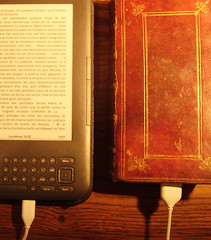
book and ebookMy library is heading up a really cool project that I thought I’d tell you guys about.

In short, we thought we’d write a novel.

A community-driven novel, that is. Here’s a blurb about the project: “A community novel is one that is written collaboratively by members of your community. The library invites writers to each contribute a chapter to advance the group’s story. The story is set in Topeka and will use landmarks and a setting that all will recognize. Writing and publication began in April and continues through August with a chapter added each week (just like any other serial novel you’ve experienced). Each chapter will appear here so you may read them in order, with a new chapter published each week.”

Here’s a link to the main page for the project, and here’s chapter one. Please read it!

When we’re done writing the novel, we plan to throw an author book signing party! We also plan to publish the book in both ebook and print formats, and sell it online. And we’ll put the book in our collection, so people can check it out.

We have two goals:

  1. We want to showcase content creation in our local community, and this type of focused writing project provides us with a fun way to start doing that.
  2. We also want to get our feet wet in content creation. Libraries traditionally house books, help customers find books, and create programs around books and authors, etc. Why can’t a library and a community … create a novel?

Anyway – check it out – chapter two comes out this week!

book pic by Remi Mathis

4 comments

Social Media as Place

by David Lee King on January 19, 2012

My last post about those billboards reminded me about the difference between a library’s normal forms of content (books, DVDs, music CDs, etc) and social media.

What’s that difference?

  • Content – a book, a video, etc – is something you DO. You read a book, you watch a movie.
  • Social Media is a place you visit in order to DO. You visit Facebook in order to share something with your mom.

Think of social media as a crowded room in a pretty social setting. A bar, a party, hanging out with friends, etc. You go there to talk, to share, to listen. It’s a place you visit so that you can do something.

There are a couple of cool intersections though. Things like this:

  • Go to Twitter (a place) to talk (something to do) about a book that everyone’s reading (content).
  • Visiting the library (a place) to use the computer to access Facebook to reconnect with a friend (something to do).

So librarians … use your mad powers of social media to connect with your customers to talk about your content. Then see what happens.

image by Bigstock

2 comments

The Daily Grape and the Daily Book?

by David Lee King on June 7, 2011

Gary Vaynerchuk, who made videos about wine at Wine Library TV and now at the Daily Grape, has a really cool idea about how to add value to his wine videos, and to help his viewers keep track of (and buy) wine they’re interesting in trying.

Here’s what Gary wants to do (from episode #1 of the Daily Grape):

  • Create mobile app-based video (and have a web-based version too)
  • Make his videos shorter
  • Make the content entertaining and usable
  • Created a mobile app (Daily Grape in the iTunes app store) that goes along with the videos

Gary noticed that he mentions a lot of wine, and some of his viewers forget about the wine after they’re done watching the video. So why not make an app to solve that problem?

Here’s how Gary’s app works:

  • sign up for a free account through the Daily Grape app.
  • Then, watch one of Gary’s videos
  • If you like the sound of a wine Gary mentions, you can click through to the video details, and add the wine to your wish list.
  • Then you have a handy list when you’re at a restaurant or a wine store.
  • You can also comment on the wines found on the app.

Cool idea, huh? Believe it or not, I think this could work for libraries, too. More wine for everybody! No, just kidding.

We have books, don’t we? My library has a collection of almost 500,000 books/videos/etc. Do you think our patrons can remember all those titles?

Right – probably not. But that’s why some of the newer ILS’s include things like wish lists, tags, and comments. I’ve seen some library catalogs that let you take those wish lists and turn them into RSS feeds, which gives your patrons the ability to embed their lists wherever they want.

That’s cool. But what if library staff did the same thing? Why not keep a running list of staff picks that can be discovered in the catalog and on the website. And on the library’s blog sidebar (since it’s embeddable). And in Facebook (with a little coding added in).

In fact, my library is already providing some of that, in the form of blog posts with links to good books that happen to be in our collection.

So – just a slightly different, slightly more purposeful way to think about content created by library staff. Be a bit purposeful, like Gary Vaynerchuk – direct your customer to good content, help them check stuff out – and provide them with ways to remember the books they want to read.

Do you do that? If so – how do you do it?

2 comments

That library smell – it’s the smell of death

by David Lee King on November 9, 2010

Stephen Abram recently posted Are Books Smelly? Fun read – learn all about why old books smell!

And I have to admit – I’ve been thinking about “that old book smell” that some libraries have for awhile now. Here’s why – it seems to me that the smell some of us relish in a library is:

  • the smell of books that haven’t moved off the shelves in a very long time
  • which equals =
  • the smell of a library NOT BEING USED
  • which equals =
  • the smell of death

Have that lovely smell of rotting glue and mold in your library? It means that your stuff isn’t relevant, and it’s been sitting for too long. You have two choices:

  1. pay people to move your stuff around
  2. get better stuff

OK – probably more than two choices – you could also learn to market and promote better, actually weed your collections more often (ie, we still have Windows 98 for Dummies – both copies are available!), etc.

Yep – another way to look at change, with a sorta-kinda-measurable tool (ie, the smell-o-meter). Get people using your stuff, get rid of the stuff that’s no longer moving. Left with nothing? Maybe you’re buying the wrong stuff.

Quoting Seth Godin – “change is a bear, but it’s better than death.”

pic by antmoose

13 comments

What’s a Real Book?

by David Lee King on April 20, 2010

While I was at Computers in Libraries 2010, I listened to David Ferriero, the Archivist of the United States (he gave one of the keynotes at the conference). During his interview (Paul Holdengraber from New York Public Library interviewed him), he was talking about books and what he likes to read … and mentioned that he prefers print books over ebooks (he likes the aesthetics of paper books).

That’s fine – I get that.

But then, the audience … at Computers in Libraries … applauded! Like he’d just won an award or something. And soon after, someone tweeted “Yeah! David Ferriero still reads REAL books!”

Huh?

Help me out here – what’s the most important part of a book – the paper? Or the stuff on the paper? Anyone?

Do authors really think about paper when writing books (I know I didn’t when I wrote my book)? Most likely not. Instead, they’re thinking about the next twist in the story, or how to adequately describe that next thought.

Does anyone applaud when someone says “I still watch Super 8 movies?” How about if someone said “I still love reading print journals?” Nope. No applause there. No one would tweet “Yay! He still reads REAL journals!”

When I read something, here’s what I care about:

  • getting sucked into the story (with fiction)
  • learning something new or interesting (with non fiction)
  • being entertained and engaged (with both)

For me, this happens via paper, my iPhone, my computer, an audio book, an ebook reader, or online. I’m guessing you’re reading just fine right now.

So my point? I think it’s time for us librarians to get over our paper fetish.

Content and container – the two are really, truly, different. Books are stories or a largish chunk of non-fiction text – novels, biographies, histories, etc. The format or container? This tends to change (though it hasn’t in a long time).

Don’t get me wrong. I’m not saying books are bad. I’m also not saying print is bad. But I am saying that when lots of people applaud someone … at a conference dedicated to computers and the web … for favoring one container over another, it shows our bias, it shows our professional bent … and that bent needs to be adapting and growing and watching the horizon.

pic by Adrian

38 comments