http://www.davidleeking.com/wp-content/themes/thesis_16

Posts tagged as:

Conferences

Organizing a Podcamp

by David Lee King on September 21, 2009

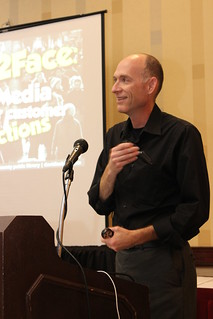
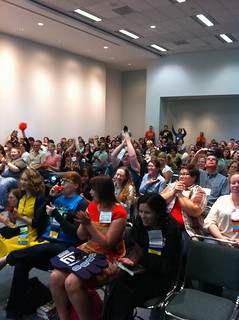
This past Saturday, Topeka & Shawnee County Public Library co-hosted (with WIBW Studios) our first Podcamp  – Podcamp Topeka. Don’t know what a podcamp is? It’s an unconference dedicated to web 2.0 tools and social media (read more about them here). It was a blast! You can some of my notes from the day here, watch my video about it above, and you can read Brandon Sheley’s notes here (he attended and lead a session or two), and even watch a quick video from channel 49 news.

So – how did I organize this thing?

OK – first things first. It’s a podcamp – there’s really not much conference planning to do. The details revolve around meeting rooms, food, and potential schwag – not the actual conference schedule. The important planning revolves around how many people you hope to attract – you have to have enough space to accomodate them. Also how long each session should be – and be able to accomodate that. Then, it runs itself (more on that in a minute).

Use your contacts for help. I poked around a bit on the interwebs, and found out Ryan Deschamps, cool librarian and blogger at The Other Librarian,  had organized some very successful podcamps. So I asked him for tips, and he emailed me some great advice on how to run a podcamp.

Sponsorships – the library provided meeting rooms and our other sponsor, WIBW, paid for food and t-shirts. How’d that happen? In this case, I know Jim Ogle, the general manager of WIBW, and also know he’s excited as I am about social media and 2.0 stuff. So I asked him if he wanted to help plan the podcamp, and he did … and he ended up being a sponsor, too. For future events, I’m told that some local organizations might potentially be interested in sponsoring the event.

Ask for Specifics. Know how much money you need up-front, then ask specifically for your needs! Much better to have a plan for what you need (and what they’ll get out of a sponsorship) than to vaguely ask for “a sponsorship” hoping someone will provide what you need.

Registration: it was a free event, but I asked everyone to register, since a head-count was involved for t-shirts and food. Eventbrite worked GREAT for this! Free and easy to use – we had over 100 registrations. I was able to email a reminder to all attendees 3-4 days before the event through Eventbrite’s admin side. They actually sent me a couple of pre-event emails making suggestions on how to run an event (ie., do you have nametags?), too.

What actually happened?

People goal: our goal was up to 150. We had over 100 people register, and approx 50-75 people actually attend. Not bad for a first time.

Interestingly, we had an odd but fun mix of people. We had a variety of skill levels from experienced user of 2.0 tools to extreme novices and an age spread from probably age 20 -85 (someone actually came up afterwards and told me how old she and her friend were). So we improvised a “Basics of Social media” session that turned into one of our larger sessions.

Food and t-shirts: I went ahead and ordered t-shirts and food for 150, not knowing how many would really show up. So we had … a LOT of food. And I have a box of Podcamp Topeka T-Shirts in my office…

Schedule: You can see it here – we ended up with quite a few great topics and sessions!

Planning details: PBWorks (used to be PBWiki) worked great. Here’s our Podcamp Topeka Wiki.

Advertising: This is interesting. We advertised in our library newsletter, in 2.0 tools (twitter, facebook), on our website, at a social media group’s Ning site, and were lucky enough to get a TV spot or two (since WIBW was a co-sponsor). We asked attendees to fill out a “how you heard about this” flyer – only 22 people filled it out. But look at their responses to where they heard about our podcamp:

TV – 4
friends – 2
twitter – 2
facebook – 2
our website – 2
didn’t say – 2
social media KC Ning group – 2
online – 2
invite – 2
Google – 1
tscpl email – 1 (guessing it was our enewsletter)

That’s a pretty large spread of responses!

And finally, Feedback. What did attendees think of the day? Honestly, most of the feedback I received was some form of this – “What a GREAT day! When’s the next one?”

So – we’ll have to start planning the next Podcamp Topeka, I guess!

{ 5 comments }

Where Will David be this Spring and Summer?

by David Lee King on February 18, 2009

Speaking at the National Library of SpainI’ll be doing a bit of speaking, traveling, and conference attending this year – here’s where I’ll be through July:

  • February 25 – Webcast for SLA, Basics of Website Management, Part 2 (ok – no traveling on this one. Yay!)
  • March 12-17 – SXSWi (attending and geeking out)
  • March 28-April 2 – Computers in Libraries (one presentation, two preconference presentations)
  • April 22 – SEFLIN, North Miami, FL area – two presentations
  • April 24 – Lincoln City Libraries (Lincoln, NE) staff day
  • May 6 – Massachusetts Library Association
  • May 7 – Capital District Library Council, Albany, NY
  • June 19 – NEFLIN, Jacksonville, FL
  • July 9-15 – ALA in Chicago

And more to come, I’m sure. Make sure to say hi – always more fun when I know people!

{ 1 comment }

Notes from SEDIC

by David Lee King on October 2, 2008

SEDIC Conference in the National Library of SpainThe last conference I spoke at in Spain was for SEDIC (Asociacion Espanola de Documentacion e Informacion) in Madrid. Here are the notes I took during the other sessions.

Introductions:

  • Milagros del Corral Beltran (the Director of the Spanish National Library): opened session, thanked the U. S. Embassy for participating, then mentioned something about how U. S. libraries are doing lots of 2.0 stuff.
  • Rosario Lopez de Prado (president of SEDIC): talked about web 2.0 being an easy to use set of tools. Mentioned that SEDIC was another great tool for libraries. Said the U. S. Embassy was a great example and leader.
  • Margaret H. Bond (Agregada Adjunta de Prensa de la Embajada de EE.UU. – she worked at the Embassy): she said some nice things about me, and some other stuff, too … about then, I stopped listening for a sec, because I noticed that every time the photographer (there was an “official” photographer at the session) took a flash photo, the translator headset I was using made a popping noise… and I found that rather interesting and distracting… :-)

Next up – a session on Learning 2.0 in Spain!

Natalia Arroyo spoke first:

  • Natalia gave an overview of how their learning 2.0 program went. I think she said this version was primarily for para-professionals (which is pretty cool).
  • [then the interpreter told me she needed to rest her voice for when she interpreted me, so stopped interpreting for awhile - so I didn't catch all of this session]
  • She discussed their goals: to create a learning community, spontaneous learning – student to student, continuous learning, hands-on
  • It went for 8 weeks. Look at these numbers: 8 instructors, 1190 participants!
  • More than just Spain – they had Latin American and Portugese participants, too.

Isabel Fernandez spoke next about the wiki they set up for the Learning 2.0 program:

  • she discussed how and why they used a wiki
  • the wiki focused on introducing 2.0 tools
  • gave a general overview of wikis
  • Mentioned Ohio Universities Biz Wiki as a good example (go, Chad!). Also the Seville Library wiki.
  • Mentioned the Library Success wiki, too (go Meredith!)
  • Also mentioned an academic library 2.0 wiki (not familiar with that one)
  • Had a couple great ideas for encouraging and growing participation on the wiki: thank users personally, welcome first-time users, and acknowledge the wiki writers’ work.

Then I spoke (I’ll share my presentation in the next post).

It was a great day, great content, and wonderful librarians.

{ 0 comments }

Final Thoughts on SXSWi2008

by David Lee King on March 13, 2008

I had a great time attending my first SXSWi conference! As you can tell from the notes I’ve been posting the past few days, there was a lot to do at this conference. Here are my final thoughts about the conference, the sessions, and why I think everyone reading my blog should attend SXSWi 2009! If you’re interested, here is a video of one day at SXSWi from my videoblog.

First off, for the sessions. The sessions I attended (save two) were really good: on-topic, good speakers, and made me think. Two favorites:

  1. Quit Your Day Job and Vlog – I’m very interested in the topic, so it was cool to see some of the “highly watched” vloggers explain how they started and what they do. And the room was full of “Internet Famous” types, so it was slightly surreal, too. Cool session.
  2. Kathy Sierra’s session – I don’t think Kathy has spoken much this past year (could be wrong about that), so it was great to see and hear one of my personal favorite blog hero types speak – if you’ve ever read her blog posts, that was how she spoke. Very useful stuff, too.

Other sessions I attended covered a wide range of geek-related topics, including blogging, making money on the web, connecting with people, web design, usability and wireframing, community management and gaming.

The keynotes were interesting. Three that stood out for me:

  1. Mark Zuckerberg (the Facebook guy) was just fun to listen to – a 23 year old coder geek with a great idea. Also interesting was watching the audience revolt develop, and then reading about it on twitter the rest of the evening.
  2. Jane McGonigal – evangelist on gaming and how it relates to experience (she called it happiness). Amazing stuff.
  3. Frank Warren, the Post Secret guy – he received a standing ovation. He seemed very into helping people share their stories. He sees his sight as a form of art and as a type of public, yet anonymous, confessional. Amazing session.

Other takeaways before I bug you to attend next year’s conference.

SXSWi attracts a different crowd. Instead of librarians in khakis, SXSWi attracts creatives of all types. Noisy creatives that will let the speaker know if he/she is stinking to high heaven. During the session. Then they’ll already have blogged, twittered, flickr’d, and youtube’d it by the end of the session.

There were at least three major reasons people attended this conference:

  1. To learn stuff in the sessions (that’d be me)
  2. To network – when you met someone, you exchanged cards and told people what you do – in your “real job” and in your “day job.”
  3. To write and video other attendees! http://sxswvideos.com/ The place was literally crawling with video teams, looking for “Internet Famous” people to chat with.

Remember that if you DO attend, you will most likely be flickr’d or video’d somewhere along the way.

The evening parties are fun! It provides a chance to mingle with other attendees in a less hurried, “I have to get to the next session” way. Many of these events have free food (ok, and free booze, too).

Everyone seemed friendly, and everyone I talked to seemed to think it was cool that a library sent people to the conference.

And… pretty much everyone had an iPhone. Seriously.

Now – for us Librarians. You need to attend!

This year, there were somewhere between 10-40 librarians attending (not scientific by any means – just my best guestimate). I think more of you should attend! Why? Let me illustrate what I mean:

  • you can go to computers in libraries and hear a librarian talk about Facebook
  • or, you can attend SXSWi and hear the creator of Facebook talk about Facebook

Both are valuable. It’s great to hear what other libraries are doing with these new tools, and obviously we need to network with each other. But sometimes, it’s also good to hear what the non-library organization is doing… and it’s good to meet the people creating the tools we’re using!

Who should attend? You. If you read my blog, you’re a great candidate for going to this conference. I guarantee you’ll learn something new. Other emerging tech librarian speakers – you know who you are. All the “webish types.” All the “digital strategy/2.0″ types. Give it some thought!

Even better – submit a panel idea!

OK – attending is one thing – speaking is another! Why should you submit a panel idea? We already know a lot of the stuff I heard. Here’s just one example: Jane McGonigal gave a great keynote presentation focused on gaming and how it’s changing real life. But I’ve already heard most of what she said… from librarians!

My point? We already have a good grasp on technology, online community, and content from an information professional point of view. I think SXSWi could really benefit from our knowledge of content, search, and knowledge management. The speakers I saw, for the most part, know a lot about web design and online community. They don’t have a clue about metadata, standards, working with non-digital types in a digital world, and in many cases, even using a service for an organization rather than a personal blog

And hey – we’re considered sexy and cool at the moment, so it’s maybe a good time…

{ 3 comments }

SXSWi 2008, Day 4: Life After the iPhone

by David Lee King on March 11, 2008

I thought this session was supposed to be about this (from the SXSW summary of the panel):

“The iPhone may be the most disruptive technology of this decade. The countless ubiquitous computing tools available to User Experience professionals mean convenience and usability headaches. With boundaries blurring between web and mobile, how will the UX discipline change? This panel explores challenges for designing Rich Internet Applications for multiple devices.”

That sounded interesting. Unfortunately, the actual panel was nothing like the above description. This presentation had: no info and no real thinking about the future.

More than one panelist said they like other phones better (so what in the world are they doing on this panel – according to the description given, they were supposed to do a bit more thinking about the iPhone, how disruptive it is, and the future).

One panelist said the iPhone was hard to use, another complained about the SMS capabilities and how hard they are to use.

Hmm… I’ve seen like 5000 iPhones this week, all being used successfully.

But enough about that! Fortunately, I’ve only attended two really bad presentations.

{ 8 comments }

SXSWi2008, Day 3: Pimp Your Non-Profit

by David Lee King on March 11, 2008

Moderator said agencies don’t like to work with non-profits – because we’re passionate about what we do. How funny.

Work with management to make sure the important stuff is written into job descriptions, or it won’t get done – extremely important!

Reproducible – if you create a cool techie thing and then leave – can someone else do it?

Empowerment – make sure the tech empowers your staff – something that will excite them, empower them, so that the enthusiasm can spread

Beth Kanter (one of the panelists):

“getting good poke”

strategy
most important thing – make it personal
Will it scale – will passion scale?
she showed a “ladder of engagement” graphic

[aside - nothing against the other panelists, but I would have liked to hear Beth for the whole hour! She was pretty interesting]

Three Rs of networking… something else? Missed it:
relationship building
rewards – important (even a PBS coffee mug works)
Reciprocity

she used her social networking contacts to raise money for something, and it worked – she ended up winning a “raise money” contest

{ 1 comment }

SXSWi2008, Day 3: Frank Warren’s Keynote

by David Lee King on March 11, 2008

Frank Warren does the PostSecret blog

Starting off with a video Frank made of some of the secrets from his site – nicely done

He put some postcards in the back of the room – here’s one secret that was filled out: “My large company sent me here to steal ideas from start-ups – I’m pretending to be a freelancer.” [aside - yes, there are some scumbags here]

When we feel like we’re keeping a secret, it can hold us back – he’s enabling a form of confessional

Frank’s a good speaker – he’s doing all the right speaker things

Wow – he started out by physically collecting secrets – he passed out postcards on the street, asking for secrets – then posted the postcards on the wall of an art exhibit

He stopped when the exhibition stopped… but postcards kept coming to him, so he created his blog

The band that cut “Dirty Little Secret” used his postcards in a music video – Frank didn’t take money – instead, he asked the band to donate to a suicide hotline. Nice.

showing some secrets that the lawyer didn’t allow to be in his book for copyright or privacy reasons

interestingly… by sharing these at this particular conference, he IS publishing them – they are being photographed and filmed and blogged… hmm

he used his community built up around the blog to raise $30,000 for another suicide hotline that was having financial troubles – they raised the money in a week, and saved the hotline.

He keeps the barcode stickers on because it shows the journey the card had getting from the person to him, and it provides a sense of authenticity

Picasso said “there’s an artist born in all of us”

Someone shared a “secret” – he proposed on stage… and she said yes! Neat.

{ 1 comment }

SXSWi2008, Day 3: Social Networking and your Brand

by David Lee King on March 11, 2008

Coolness – they’re taking questions during the presentation using twitter – twitter.com/snayb4sxsw – great use of twitter!

panelists:
Paul Boag, Jina Bolton, Mark Norman Francis, Steve Ganz, Steve Smith

Defining social networking
it’s something we’ve done forever – even before the web

ways to use personal brand
not just logos and letterhead
your brand is simply the promise of an experience

ways to use personal brand:
Boag – his company used his personal brand to push some stuff out, because he was already well known in the field

Names
some brand themselves by their personal name – some have to use different names/personas to stand out from the crowd (Steve Smith talking here)

[me talking - that's why I use my middle name - it helps differentiate me from the millions of other David Kings out there]

Then you have to be consistent – always use that name

Tips & Tricks:

Pics – use a consistent avatar/icon/thumbnail pic, too.

Commenting – can affect your brand. Some people leave rude comments… you can be polite…. this type of thing can leave good or bad impressions of you.

SOme people give up when they don’t immediately become internet famous – you have to be consistent, and keep keep it going – it’s lots of work.

Represent your self as who you are – be yourself.

Keep your attitude the same as if you were speaking to someone face to face

when it’s a personal brand, you have to watch what you do – don’t necessarily want “I’m wasted” in the same place where potential clients are watching/reading…

stuff can get taken out of context – be careful what you twitter…

Tools:
twitter is used much (the linkdin guy said this)
Paul (a podcaster) says Podcasting!
Campfire, email, IMs, private chatrooms
Bolton – twitter, IM, etc are NOT social networks – they enable social networking – nice differentiation

How do we deal with all these pieces out there?
Reserving your name – dangerous to not get your name in that social space – you want to grab it up before someone else does.

Is it a detriment to get it and then not use it? Not necessarily

The Real World
How do you keep in touch? Email feels too formal. Paul uses Twitter and flickr – you can sort of follow their lives without interrupting their lives so much – and then when you meet up with them again, you have something to talk about

Paul takes business cards he gets at conferences, puts them in his contacts list, and finds a pic online to associate it with – helps him put a name and a face together

Lots of the panelists mentioned flickr as a great way to know the person, know their lives

Balance between private and public stuff
be aware
use the privacy controls if needed
bring out personality, who you are rather than specifics…
you have control of what you put out online

{ 2 comments }

SXSWi2008, Day 3: The Art of Self Branding

by David Lee King on March 11, 2008

artofselfbranding.com

branding yourself
no restrictions, very personal, organic

Brands are built upon what other people are saying about you – not what you are saying about yourself

Dang… didn’t save, and lost a couple of notes.

Speaker is comparing Mint and Wesabe in terms of branding. Mint wins, hands down. One example – names. Both are financial services companies – Mint makes sense, is easy to say, has pleasing experiences behind it (they use a mint leaf in their logo). Wesabe? Not so much.

Consistency is key – poor branding is all over the place.

{ 1 comment }

Kathy Sierra’s session, as you can expect was great. She’s a talented speaker, and has good stuff to say. She did, however, assume that most people in the audience had heard lots of her presentations in the past – so she went really fast, and at some of the points below simply said “you’ve heard me cover this one before” … so she didn’t cover it!

[note to speakers: you probably hang out with all the other cool speakers. Just because you and they "know everything" doesn't mean your audience does - go ahead and share the basics and stuff that feels like you're repetitive].

And now, here are some incomplete notes from her session:

Difference between fabulous and average:
- not about natural ability
- about the ability to practice/put in the time

20 ways…:

1. use telepathy. There are two flavors of neurons: mirror and motor. They feel the movements and read emotions.

Visualization – you have to see the thing you want to do in your head – that’s sort of like practicing

2. serendipity: psychic shuffle – it’s that “I was thinking about this song, then it played” moment. So add randomness.

3. The Dog Ears principle. Ears come after the head. Think about real life physics when you design.

4. Joy

5. Inspire 1st person language – really shouldn’t be about you.

6. T-Shirt-First development

7. Easter Eggs and other treats. Leave “treats” in your design, things that are there for no other reason than to make people smile. “A smile in the mind” – title of an interesting-sounding book.

8. Tools for evangelism

9. You are a… : You are a predator – predator’s eyes are in front of their heads. So right now, there’s 400 predator eyes looking at the speaker! Learn how to manage your fight/flight response. There are tools for this – ie., Stress Eraser, a breathing game – also calms you down.

10. excersize the brain – BrainAge as an example

11. Give them spuerpowers, quickly.

12. ???

13. Speed their knowledge

14. Make product (or Do’s) share your feelings

15. Help with reinvestment of mental resources… focus – have to devote all your attention on it. Attention offsets vs partial attention

16. Create a culture of support – no dumb questions, no dumb answers

17. Do not insist on inclusivity. Jargon is ok – passionate users “talk different”

18. practice seductive pacity – mystery, anticipation, curiosity

19. Atoms are NOT old skool – if you make digital stuff only, give out t-shirts – something people can hold

19.5. Do what this guy does – Gary ??? – does a radically different, passionate wine show. Gary is making his viewers entertaining – he is taking the focus off of himself

{ 2 comments }