http://www.davidleeking.com/wp-content/themes/thesis_16

Posts tagged as:

customer service

Showing Patrons the Door

by David Lee King on February 3, 2010

First, a funny story. When I lived in Nashville, I frequented a cool used record store. During one trip, I was trying to decide whether or not to buy a couple of old jazz cassette tapes (hey – I was on a tight budget).

The tiny shelf these cassette tapes were on was packed WAY too tightly, so when I tried to pull one cassette out to examine it, 2-3 others would fall out at the same time. And make lots of noise as they hit the floor (it was tile, of course). This happened a couple of times … in a row … and was pretty embarrassing!

So – to ease my embarrassment at not being able to figure out how to successfully pull a cassette tape off the shelf, a “helpful” shop security guard came over to me. He stood behind me, stared at me for a second, and said (and I quote) – “you’ve got 10 minutes, then you’d better be out of my store.” Then he walked away.

Boy, that helped. Thanks :-) That day, the store essentially “showed me the door” in no uncertain terms. Even though the problem wasn’t me – it was their tightly-packed shelf.

Now on to the title of this post, and to my point. Showing patrons the door? Yikes – we’d never do that (under normal circumstances, anyway)! Unlike the silly used record shop, librarians would never consciously walk up to a patron and tell them to leave if that patron was having trouble using something in the library … right?

I think we DO sometimes tell our patrons to leave when we make things difficult for them. We might as well be saying “here’s the door, don’t let it hit you on the way out.”

For example, if your library has a blog, do you moderate those comments? Quickly? I know of libraries that can go 1-2 weeks before they get around to moderating comments. In and of itself, moderating a comment is fine, as long as they are moderated fast (like within 1-4 hours). Blog posts are supposed to be the start of a conversation; comments continue that conversation. If those comments aren’t approved at least in the same day, you have essentially killed that conversation. To me, that sounds like showing patrons the door.

Is your website confusing? Do customers have to puzzle out what they need to do next while on your site? If so … your website is showing patrons the door. Same with our catalogs – a confusing catalog might just steer customers away from checking stuff out – and that’s one of our major, must-have services!

Do you let patrons sign up for a library card online (some libraries don’t)? How about having an online sign-up form that asks for WAY too much info? That’s a sure-fire way to show patrons the door.

What labels and naming schemes do you use on your site? Using heavy-duty librarian jargon might just be a great way to usher patrons towards the door.

How about not having a Facebook Page (or even blocking Facebook altogether)? Or simply doubting that your patrons use Facebook (without actually signing up for a Facebook account and checking)? Yet another way to show a group of very active, involved patrons the door.

Other ways to show patrons the door might include hard to find stuff on your website, hidden content, or even library services that aren’t mentioned anywhere on your website.

So – what do you think? What else shows patrons the door, and how can we fix that?

Pic by Cayusa

{ 11 comments }

Stickers or Cushions?

by David Lee King on December 13, 2009

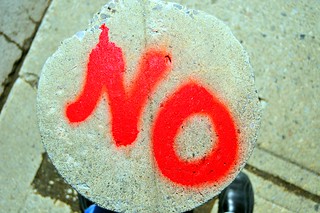
No seat or unintended consequences?Take a look at this pic – it’s at the Chicago O’Hare International Airport Denver airport. I really don’t know the why’s behind this sticker, but I can guess. And I’d guess it goes something like this:

When the moving walkway was installed, they made these little metal ledges. Maybe the ledge houses a belt, or gears … maybe it’s just for looks. Who knows?

Either way, as the airport got busier, and delays started happening more often, customers looked around for a seat and couldn’t find one. Then they eyed that handy, seat-sized ledge … and sat.

When airport staff noticed that lots of people needed seats, and were using those handy little seat-sized ledges, what did they do? Did they install more seats? An overflow room? Restaurants with more seating? Nope. They chose to put a big fat sticker on the seat-sized ledge that reads “no seat.”

So – a question. Who do you think airport administrators were thinking of when they created that sticker and stuck it to the makeshift overflow seating area? Were they thinking of their customers, who didn’t have a place to sit? Or were they thinking of their staff? I’d guess the airport’s decision had more to do with themselves than with their paying customers with tired legs.

Moral of the story? Always put your customers first. In the airport’s case – instead of a “no seat” sticker, how about putting out cushions? Work hard to always improve your customers’ experience while using your services, even with the seemingly innocuous things (like little seat-sized metal ledges).

Your customers will remember it and you will be a hero.

Update – Chuck Cannon, Director of Public Affairs at Denver International Airport pointed out that I had the wrong airport. Sorry! Just updated the post.

{ 16 comments }

Extreme Customer Service at Darien Library

by David Lee King on May 11, 2009

I recently visited Darien Library with the goal of checking out their innovative approach to technology – goal achieved! Check out the video in this post (and thanks to John Blyberg for the tour and for putting up with my video camera!). While their technology is amazingly cool, that’s not really what excited me. What excited me most was Darien’s idea of extreme customer service.

During my Darien visit, I had the privilege of chatting with Louise Berry, Alan Gray, and John Blyberg over lunch (great lunch, great conversation – thanks guys!). We talked about technology, new library buildings, and how we should be serving our library customers. Louise and Alan told me about their library’s core message – extreme customer service. Basically, they want to demonstrate extreme customer service in everything they do.

This idea of a “core message” is discussed in the book Made to Stick: Why Some Ideas Survive and Others Die by Chip and Dan Heath. Most of the book is devoted to making your core message “stick” – this is what Darien Library has done.

They even provided examples. During lunch, Louise, Alan and John mentioned an after-hours wine and cheese event they held at the library. The library was closed, but doors were open. Patrons not attending the event came in anyway … and guess what? They weren’t turned away – instead, they were allowed to check out books (RFID-based self-check-out machines help). Staff were even seen setting up new library cards for patrons. This is very different from what many libraries do. For most after-hours events, patrons would simply be told (nicely, I’m sure) to come back tomorrow.

So – one example of extreme customer service at Darien. You can find another example in the video. Watch for the mini laptops in the children’s area of the library. Those are staff public service laptops used for roaming reference type stuff. But listen to the children’s staff talk about them – kids pick those laptops up and use them. Patrons even use the public service desktop … and Darien’s staff is fine with that! When I asked about this, here’s what I heard: “why would we NOT allow that?”

John said the same thing later on in my tour (not captured on video). We were in a staff area, and I noticed someone had brought in her personal laptop. I asked what she could connect to … and John said staff can bring in their personal laptops and connect to Darien’s staff-only network. I pried a bit further, and this is when John said “why would we NOT allow that? It would simply hinder their work!” Then John went on to explain that they plan for the exceptions and fix those things, rather than lock down technology so much that it hinders the work of the library. Extreme customer service for their staff, too!

Does your library have a core message, and how does that play out? And … does your library lock technology down so much so that it hinders the work of the library? What would happen if you opened that can of worms up? Would any escape? Something to think about…

{ 9 comments }

Be Nice to Customers – Even Online

by David Lee King on April 29, 2009

Remember all that Domino’s Pizza craziness of a week or so ago? This video, originally from the Today Show, explains what happens after the fact when employees do stupid things online – in this case, the employees were apparently fired (among other things – watch the video to find out more).

Thankfully, that type of sheer stupidity towards customers would NEVER happen in a library, right? After all… we’re trained professionals. We paid for two years of grad school to be able to work with people! And we hire para-professional staff who ALSO love to work with the public. Right?

Well. Check these tweets out:

Good customer service?

or:

Good customer service?

… and one more:

Good customer service?

Now, of course I realize these tweets weren’t meant for the actual patron to see – the librarians in all three screenshots most likely really DO have great customer service skills, and were simply frustrated … so they decided to vent via Twitter (in Twitter’s  public feed. Oops).

But still.

I think there’s a HUGE GRAY area right now in the online world. Many of us are using these tools for work AND for non-work stuff. And it’s confusing! Some people set up two Facebook accounts/IM accounts/Twitter feeds. Some (like me) blend them all together. My Twitter feed flows into my Facebook feed, sometimes with some unintended consequences (well ok – usually I just get something like “David, I have no earthly idea what you’re talking about” from an old high school chum).

But still.

What happens when said “dumba**” in the screenshot above decides to use Twitter, wants to connect with people … so he/she does that “find everyone within 20 miles of this zipcode” search, and discovers the librarian virtually hollering at him/her?

In some cases, these lovely little quotes can be found pretty easily … and can also be traced back to the owner of the words (and the library that person works for).

Then what? Does the library director have to issue a statement (like the CEO of Domino’s did)? What happens to the librarians above when their library director discovers Twitter?

What do you think? Do you vent about your patrons online? Do you keep separate personal/work accounts in the social networks you frequent?

{ 30 comments }