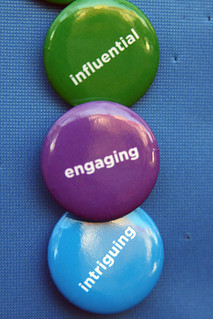
engagement

What do you Want from your Facebook Page?

by David Lee King on November 28, 2012

looking closer at Facebook PagesThinking a bit more about my last post on using Facebook ads to actively seek out new fans … Why try to get more fans in the first place?

Another way to ask that – What exactly do you want from a Facebook Page?

Here’s a list of 5 things libraries might want out of a Facebook Page. These five things are a happy convergence of stuff Facebook is good at, and stuff that libraries (and other organizations) might find useful, too. See what you think, and add to my list!

Five things a Facebook Page is good for:

  1. Visibility – the more we interact, the more we are “seen” in Facebook. Which means that more people see our posts about library stuff.
  2. Listening – we share, but we also listen to our customers. They say stuff about us on Facebook! Some good stuff, some bad stuff. It’s a place to answer questions, to field complaints, and to actively ask for input. For free.
  3. Advocacy – this one’s huge, and should be a constant. Share good stuff about the library, and point out when we see customers saying good stuff about us.
  4. Purposeful Engagement – why gather a crowd if you don’t ask them to do anything? We should be including Calls to Action in our Facebook Posts, on specific things we want our customers to actually do. That might mean Liking the page, or it might mean attending a movie at the library. We need to start asking … and then measuring results.
  5. Conversions – Doing that Purposeful Engagement thing in #4 can lead to “conversions.” What’s a conversion? Simply stated, a conversion in social media is when your ask turns into their action. For example, if you ask Facebook Page visitors to register for an event at the library (and supply a link to the registration form), and 20 people actually click the link and fill out the form, that equals 20 conversions. Conversions can be measured and improved upon. But the important point here – you WANT conversions. You want to drive your Facebook Page visitors and fans to actually DO something – to interact with and engage your library. Conversions provides a way to measure that interaction.

Those are my five things … What are yours?

Photo by Flood

4 comments

Create Better Content to Create Better Engagement

by David Lee King on November 15, 2012

I’ve been seeing quite a few posts the last few weeks talking about the horror of Facebook’s changes to their Edgerank algorithm for Pages. For example, here’s a post about Mark Cuban’s complaints about the recent changes.

In the article, a company named Pagelever disagrees with Cuban’s analysis, saying this (among other things):

Facebook has been putting posts with low or negative engagement toward the bottom of its algorithm, while allowing highly engaged posts that don’t attract negative feedback to be seen in more news feeds.

So. Simply stated, to fix this supposedly huge Facebook Page problem … just create good content. Create content that is engagement-worthy, that your followers and fans want to Like, Share, and comment on. Focus on that, and your organization’s Facebook posts will start to appear in your Fan’s newsfeeds.

Problem solved. Now go get busy.

Pic by iabuk

Be the first to comment

5 Steps to Make Your Organization Sound Human Online

by David Lee King on October 18, 2012

Be more human onlineI’ve been seeing a LOT of ReTweets of a guest post I did today, so I thought I’d share it here, too. I recently posted 5 Steps to make Your Organization Sound Human Online at the V3 Integrated marketing blog (thanks, guys!), and it was reposted at Ragan.com.

here are my 5 steps (go check out the article to see the rest of the story!):

  1. Type Like You Talk
  2. Be Visual
  3. Use Video to Connect
  4. Ask Questions
  5. Celebrate Customer Loyalty

So – check out the article, leave comments, share it, etc!

image from V3

Be the first to comment

Be Business Casual

by David Lee King on September 6, 2012

In a previous post, I said I’d talk more about being “business casual.” What exactly does being business casual mean?

First off, I have a whole chapter devoted to this idea in my new book, Face2Face (and I’d love it if you bought a copy!). If you want more detail, it’s in the book.

Here are some thoughts on how to be business casual in your interactions. These ideas work for blog posts, status updates, and even in videos:

Write Like You Talk. Most of us were taught that writing was a very formal, proper thing. We were taught to write business letters and academic papers. Guess what? Don’t write like that (Karol, guest blogger over at ProBlogger, agrees). Forget some of those rules, right now. It’s a more formal writing style, and it makes you sound more formal and less approachable.

Instead of a formal writing style, just write like you talk. This is very hard for some people to do! They’ve been trained to write a certain way, and suddenly writing in a different way doesn’t come naturally. If writing like you talk doesn’t come naturally, you can …

Say it out loud. If writing like you talk is hard for you, here’s a simple trick: Simply say it out loud. Read, out loud, what you just typed. Does it sound like you? If not, then rewrite your text so it sounds like something you’d actually say.

Write to your friend. Another trick – pretend you’re writing to your best friend, or a sibling. When you’re writing an email or a Facebook message to a friend, you probably write a bit more casually, as if you were standing there, talking to your friend. You’re familiar with that person, so you are using casual, friendly language with them.

That’s the voice you need to use (minus the inside jokes and potentially off-color language) when writing to customers.

My new book - Face2Face: Using Facebook, Twitter, and Other Social Media Tools to Create Great Customer ConnectionsWear fun clothes – not a suit and tie. If you’re a visual person, here’s another way to think about this concept (and this is why I say to write “business casual”). Picture yourself wearing casual clothes when you write, rather than a tuxedo. It’s another trick to help remove formal language from your writing. Write like it’s “casual Friday” rather than “meeting Monday.”

Use language your customers use. In a library setting, we have to really work at this one – and most businesses are in the same predicament because of industry jargon. Remove all instances of technical language and jargon on your site. An easy way to do this is to simply ask your customers what they’d call something. For example, we removed one bit of jargon at my library by asking our customers what they would call “the room where we put a book they reserved to be checked out.” We actually stationed one of our Marketing interns by our check out line for a day, and had her poll the people waiting in line. We received some great feedback – the room is now called the “Holds Pickup Room” and it works great. Our customers know what to look for, because we named it using our customers’ language. You can do a similar thing with your organization’s products and services. Pick something your customers do, and simply ask them what they’d call it.

Do some behind-the-scenes videos. Show what goes on in the office or behind-the-scenes. This type of video captures workers in their element (at the office, doing their work), rather than artificially standing in front of a backdrop, with lights shining on them, talking to a camera. You can even interview them. Blip.tv does a great job of this with their Blip on Blip video series. They walk around their workplace, taking videos of staff and and sharing those videos with the Blip.tv community. This type of video shows real people at work, having fun. Getting to know someone by watching them in a video helps customers. When a customer has to call in for support, for example, they might just “know” who they’re talking to – because they just watched that customer service rep in a video.

Represent Your Organization, not Yourself. Finally, remember this: when you share that slightly casual, personal voice, and you’re doing it for your organization … you are essentially representing that organization. You become the voice for your organization or business. Your website, your content, and your employees have unique personalities. This uniqueness will come out. Your brochures were written by people who have a voice, and some personality comes from those, too. All that adds up to an organizational personality. Even your physical building (if you have one) has a feel or personality. The challenge is to make these match so you can present a uniform image. Sit down, do some planning, and map out each aspect of your organization – the building, the marketing, the website, the staff. Plan the voice of your organization.

These are some ideas of how to be business casual online – do you have others? I’d love to hear them!

Business casual image by Bigstock

3 comments

3 Ways to be more Social in Social Spaces

by David Lee King on August 30, 2012

Successful posts in social media spaces like Twitter or Facebook are the more social, friendly posts (at least for my library, anyway). How can you be more “social” in those spaces? here are three ways to do it:

  1. Think “Business Casual.” Anyone like that formal, stilted, edited to the max writing style that appears on brochures and markety emails from businesses? Nope – didn’t think so. That type of language doesn’t help you connect to the organization, does it? So don’t do that. Instead, try to make your photos, videos, blog posts, and status updates more “business causal.” How do you do that? Here’s one way – write like you talk. That way, your posts will naturally sound more conversational. More in the next post!
  2. Ask, then Respond. Ask questions. Ask for input. Ask readers to add their thoughts. For example, if you share a list of five favorite action movies in Facebook, make sure to include a question asking readers to add their favorites, or to add what’s missing in the list. People love adding their own favorites to a list!
  3. Include your customers. So you asked your customers to add their favorites to your list in #2. That’s awesome … and that can be your next post! Compile that list of customer favorites, post it, and include everyone’s name that added to the list. The people you included might share that list out (i.e., an appeal to vanity), and more customers will add to the list, too.

So – those are some ideas to be more social in social spaces. Do you have any additions to this list (yes, I’m doing #2 right now)? Please add them in the comments below!

If you liked this post, you’ll also like my new book, Face2Face: Using Facebook, Twitter, and other Social Media tools to Create Great Customer Connections. Get it now!

My new book - Face2Face: Using Facebook, Twitter, and Other Social Media Tools to Create Great Customer Connections

Image from Bigstock

3 comments