
My library has been running some experiments and pilot projects on our Facebook Page – some on our own, and some with help from Ben Bizzle (who’s doing some research on Facebook Pages) and so far, they have been really successful. This post explains one of them.
See the ecards image? Ben had posted this to a couple of library Facebook Pages, and it was pretty successful – so he asked if I could post it to Topeka’s Facebook Page. So I did – at what I thought would be a rotten time to post – 9:08 am on a Thursday morning.
I was wrong.
This post is the most popular post EVER for Topeka’s Facebook Page. Here are the basic stats I’m getting for it so far:
- 237 Likes
- 88 Shares
- 33 Comments
And from Facebook Insights, I’m seeing this:
- Reach – 3900 (Reach is the number of unique people who have seen the post)
- Engaged Users – 748 (Engaged Users is the number of unique users who have clicked on the post)
- Talking about This – 660 (Talking about This is the number of unique users who have clicked like, commented on, or shared the post anywhere – not just on your page)
- Virality – 16.92% (Virality is the percentage of people who have clicked the story from the page post out of the total number of unique people who have seen it).
A bit more about Virality, because for us anyway, this is HUGE. The median Virality rate for Facebook Pages, according to ZDNet anyway, tends to be around 1.92%, and a really stong Virality rate, meaning your post was pretty popular, is around +2.5%.
So you can see why I’m getting a wee bit excited about a 16.92% rate, right? That is HUGE. And not just “huge for my little ole Topeka Library” huge. This is actually a pretty big accomplishment. And one I’d like to see more of on my library’s Facebook Page.
So what’s going on here? Why did this particular post get so big? Here are some thoughts on that (you might have some ideas too – I’d love to hear them):
- It’s visual. Visual is HOT right now. Think Facebook, Pinterest, Instagram, Youtube, etc. And honestly, those victorian ecard thingies are pretty hot too at the moment. So we were picking up on a trendy thing.
- Visual is also pretty useful. The image supports the message of the post, so more people get it (i.e., those visual thinkers).
- Another trend – images with words. People like finding an image and putting funny words on them. So … another trendy thing that people might enjoy if done well.
- The message connects with something our customers love. As in books and reading.
- Hit on an emotion. This particular message touched on a feeling that apparently many readers have – that horrid feeling towards the end of a book, when you know you’re almost done and there’s NO MORE. I can relate – I had that feeling towards the end of book 7 of the Harry Potter series. So we hit a nerve that our customers could relate to.
- We asked for it. We asked a question in the post (“We’re curious – does this ever happen to you?”) and people answered the question.
OK David, so you got a lot of likes and comments and shares. So what? How does that help the library? I have an answer for that. A couple of them:
- Helps your message Rise to the Top: Here’s how Facebook works right now. You don’t see everything. Most people only see highlights (called Top Stories) of the daily postings of the people and organizations they have friended (that’s the default setting – you have to actually click Sort to see everything). If you post stuff that’s popular and a bit viral, that means that those particular posts will “rise to the top” and will actually be seen by more people.
- More eyes is a good thing: When someone likes, shares, or comments on your post, that post has a good chance of being seen by that person’s Facebook friends, too. So the more interaction you get, the farther your reach spreads out.
- Like once, might like more:Â If someone likes one of your posts, they are more likely to watch for and interact with more of your posts. So be silly, funny, or tongue-in-cheek sometimes, and share links to books, events, or online resources other times. Your Facebook fans will start to notice, and will end up seeing and interacting with more of YOUR LIBRARY.
- Time of day: experiment with posting at different times of the day. We have been posting a lot at night, getting that evening Facebook crowd. By posting at 9am, who did we get? My guess – people who just got to work … who also have their Facebook account up, either on their work computer or on a mobile device sitting at their desk.
I’d love to hear your Facebook Page successes! Share away!
Oh – and if you like this post, you might also like my new book, called Face2Face: Using Facebook, Twitter, and other Social Media tools to Create Great Customer Connections. Get it now!
 This was my panel session. I shared the panel with three fabulous people:
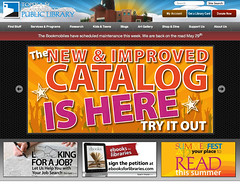 My library’s in the process of switching ILS systems – we just moved from SirsiDynix Horizon to a Polaris system (to all you non library types out there, I’m talking about our Library Catalog).
 A couple of days ago, I was poking around in my library’s