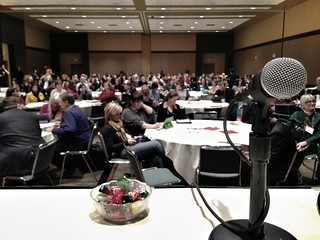
presenting

My Australia Talks

by David Lee King on September 30, 2011

While in beautiful Australia, I met lots of cool librarians … and gave a couple of presentations, too. Here are the Slideshare versions of the presentations – you had to be there to get the full effect, but still – it gives a glimpse.

Freak Out , Geek Out, Seek Out – I found a couple of Australia examples for this presentation, which was fun.

Creating Customer Experience. At VALA, I combined this one with the Freak Out presentation above.

Modern LibGeek Landscape – some Provocative Questions. A bit of explanation on this one. It was meant to start discussions, and be a bit “out there.” Hence the odd questions!

2 comments

10 Tips to Do Presentations Like Me: It’s a performance

by David Lee King on February 3, 2011

Tip #10: It’s a performance.

Oh yes it is.
Your talk is most definitely a performance, and you are most definitely a performer.

Are you on a stage? On a podium? Talking to a room full of people? Ever gotten an anxiety attack before your talk? Yep – you’re a performer.

Your presentation isn’t just the words you’re saying. It’s not just the slides, or your movements, or your transitions … it’s not even just your content. It’s all of that – content, delivery, visual cues, the way you talk, etc – all rolled up into a big wad of performance.

Those people who read “academic papers” word for word? Those people who do the PowerPoint 10-points-per-slide thing, and basically read their outline? They probably have great content. Sit down with them for dinner, and let them share – it’ll be amazing, I’m sure. But that thing they just did on the stage, in front of people? It was a performance … but probably not a very good one (and believe me – I’ve been there, done that, so I’m guilty as charged).

But you? You know better. You have great content. A great idea or new angle that you want to share. And you know that to deliver it well in a presentation setting … well, you have to deliver great content, and turn in an engaging performance, too.

No, you don’t have to be the most amazing presenter in the world. But DO give what you’re doing on stage some thought, and I’m guessing that you’ll be much more interesting than “those other presenters.”

Thoughts?

Pic by libraryman

7 comments

10 Tips to Do Presentations Like Me: Rehearse!

by David Lee King on January 27, 2011

Tip #8: rehearse!

I always do a dry run-through of my presentations the evening before I give them. If it’s a longer, multi-hour seminar, I probably won’t – but I WILL look through my slides, give some thought to how long each section should run, make sure I have time for Q&A at appropriate places, etc.

But if it’s an hour-long presentation or under? Yep – I’ll probably run through it once or twice. I know – some of you are saying “well, gee David. Glad that works for you – but I don’t need to do that.”

Really? Sure, your presentation might be fine. Yay for you. But I’m guessing this – if you DID rehearse, even just a little bit – your presentation would be that much better.

For the rest of us – if you don’t rehearse, it shows. Here’s why I rehearse:

  • To make sure my transitions work.
  • to make sure my timing is accurate (ever seen someone get the 5-minute warning at the end of a presentation, and they freak out because they still have 20 slides to go over? Sure sign that person didn’t rehearse).
  • To practice saying any specific things I want to say, and to make sure I can actually talk coherently over each of my points.
  • OK – and to feel better about the whole thing, too.

So go rehearse – your presentations will rock that much more if you do.

Pic by Suzy Glass

3 comments

Tip #7: Work on Introductions, Transitions, and conclusions.

Intros, conclusions, and transitions have always been a challenge for me – in writing and in speaking! In college, me professors frequently said “David, you need a transition here” or “you need a stronger conclusion.” So I’ve been working really hard on those transitions.

And I’ve noticed that I’m not alone. I’ve seen more than one presentation where the presenter was introduced, then starts their slides with an uncomfortable “um … I guess let’s get started now” and jumps right into the presentation. Or when they’re done, they end with a weird smile and a “um, I’m done now” (I have to admit, I’ve done that myself).

They’re not really that hard to do, either. Here’s what you’ll see me do:

Intros:

  • Usually, someone announces who you are. If they don’t, take a minute to introduce yourself. It gets you used to talking, and gets the audience used to you
  • You might start off with a question, or a statement (sort of a statement of purpose for the presentation). Then briefly cover what you’re going to talk about.

Transitions:

  • also easy. At the end of one point, flow into the next point with something that relates to it. Or at the least, say something like “we just learned about this. Next up, let’s talk about this for awhile.”
  • These transitions make it easy for people to follow along or take notes.
  • If you like to walk around while giving a presentation, it helps visually to actually move to another spot while making your transition
  • And of course, show something like “point #2” up on the screen if you’re using slides.

Conclusions:

  • Remind people what they just learned – something like “we’ve just covered these 5 things.”
  • Then I like to end with some broad statement about what can happen if you put these ideas into practice (ie., “put these easy steps into practice and you’re bound to improve your website and make your customers happy” or something like that).
  • Actually have an “I’m done now” slide. I wrote a book and have a blog, so my last slide says “Thank You,” shows my book cover, and displays my website’s URL.
  • If you know you’ll have a question and answer time afterwards, you might just show something like “Q & A time” on a slide, then say “it’s time for questions.”

Improve those transitions – I promise to work on them too!

Pic by dnnya17

Be the first to comment

10 Tips to Do Presentations Like Me: Learn Your PC

by David Lee King on January 14, 2011

Tip #4: Learn how to use your PC (or the PC you’ll be using for the presentation)

I have to admit it – it bugs me when someone stands up in front of everyone – especially at a tech conference – accidentally moves to the next slide … and can’t figure out how to go back to the previous slide.

They get all flustered, blame “technology,” and finally decide to solve the problem by getting out of presentation mode, finding the proper slide, then restarting the presentation. Or by just skipping that slide.

I get it – when we’re standing up in front of people giving a presentation, it’s weird – and we sometimes get a bit flustered when things go wrong. That makes sense.

Because of that, I’d suggest this – take 10 minutes to figure out that PC, and the software you’re using for the presentation. Find all the different ways to advance slides (spacebar, arrow keys, etc). Figure out how to go back to the previous slide (as in the left/right arrow keys).

If you’re planning to do some slightly advanced stuff like playing a video, either in-presentation or not, make sure you test it multiple times – in your office AND on stage. Make sure you know how to turn up the audio.

Do this little bit of prep work, and you’ll look that much more confident and knowledgeable. That weird feeling you get when you’re doing a speaking gig? It’ll still be there (the only way to get rid of that is lots of experience or being an uber-extrovert) … but at least you’ll know how to go back to that slide you just skipped!

1 comment

10 Tips to Do Presentations Like Me: Use Presenter Notes

by David Lee King on January 11, 2011

Tip # 2 – always use presenter notes!

The image above shows one of my slides, and the slide’s presenter notes. I LOVE presenter notes! I mentioned one handy use for the presenter notes section in Tip #1 – using them to store the outline of your presentation while you customize your slides.

But the presenter notes section really shines if you actually use it during your presentation. Ever watched someone give a presentation using a laptop and PowerPoint … but they also had a bunch of paper notes that they shuffled through and read? There’s really no need to do that … if you use the presenter notes part of your software.

Both PowerPoint and Keynote have this feature. Basically, I put the stuff I really want to say in the presenter notes box of each slide, rather than actually on the slide itself.

Doing this allows me to use the actual slide to accompany the presentation … rather than allowing my slide to BE the actual presentation (we’ll get to that idea a little later on). I’ll find an image, or a couple of words, that highlight the main points of my actual presentation, and put them on the slide, rather than my whole outline for that point.

Then I use the presenter notes as a memory aid during my presentation. If there’s a phrase I want to say a certain way – I put that phrase in the presenter notes box. If there’s a number that I can’t remember … it goes in the presenter notes box.

To me, that presenter notes box is one of the most useful tools in Keynote (my presentation software of choice).

How about you? Do you use the presenter notes box? What do you use it for? Please share!

10 comments

10 Tips to Do Presentations Like Me: Don’t Use Templates

by David Lee King on January 7, 2011

People tell me they like the way I do presentations … so I thought I’d share some tips and tricks I’ve learned along the way.

Tip #1: Don’t Use Templates

Ever. They are evil. Well, ok – they’re probably not that bad. But they sure do suck the creativity out of creating a slide deck!

Generally, I start with a clean, blank slide. I remove all the text boxes, title boxes, etc. Or just pull up an actual blank slide.

For backgrounds/themes, I usually just use a simple white, black, or gradient background (though once in awhile I’ll use a fun textured background that I find somewhere – it really depends on my mood).

From there, I actually drop parts of my outline into the presenter notes part of the slide (so I still have a blank slide). Then I start figuring out what words are important enough to actually use for the slide, and decide what type of image might work best on the slide, to support the point I’m trying to make.

Then I start dropping text and images onto the slide. I usually stick with 1-2 font styles, and make heavy use of layering and shadows (so parts of the slide “pop” out at you).

The image accompanying this blog post is the title slide to my newest presentation (giving it this Sunday at ALA Midwinter). White background, fancy font with a shadow, and some images (that relate back to the three main points of my presentation).

Simple, yet effective. And fun, too (if you like creating slide decks anyway).

10 comments

5 Mic Tips for Presenters

by David Lee King on July 6, 2010

I see lots of people give presentations … and hear lots of presenters with microphone problems.

I know a little bit about microphones and how to get the most out of them, so here are 5 Mic Tips for Presenters!

Have some microphone tips not listed? Add them in the comments!

5 Mic Tips for Presenters:

1. Get close to the mic! Most mic and volume problems are solved if the presenter simply moves his/her head closer to the mic.

  • Optimally, you should be about 4-6 inches from the mic, and an easy way to measure that is by using the clenched fist rule. Simply put your fist up to your mouth, and put the mic on the other side of your fist. That puts you about 4 inches or so from the mic.
  • Using a lavalier? They don’t have to be as close as a handheld-type mic, but you still need to position the lavalier to it’s pretty close to your head. Right under your neck is a great place for the lavalier mic, so for guys wearing ties, clipping the mic right underneath the knot of your tie works great. Women, same thing – wear “lavalier-friendly” clothes (so you have a place to pin the mic).

2. Speak directly into the mic (or slightly angled if your P’s and S’s are popping a lot). I see lots of speakers hold a mic down by their chest. Bad! Be bold, be brave … and talk into the mic.

3. Do a sound check before the event. Make sure to talk into the mic like you normally would during a presentation – so no embarrassed whispering. Also, use that time to get familiar with the mic. See if it has an on/off switch, a mute button, a battery light, etc.

4. Avoid feedback. That high-pitched, squeaky feedback is icky, and it’s really pretty easy to avoid, if you follow these three steps:

  • if you start hearing feedback, move closer to the mic – not farther away from it. If the mic isn’t picking up a strong signal from you, it will start picking up other noises, including your voice from the monitors… and that causes a feedback loop (ie., those terrible screechy noises that everyone hates).
  • don’t cover the mic with your hand. That’s sorta the same as cupping your ears (ie., more ambient noise = more likely to feedback).
  • Stay away from the monitors! If you like to walk while talking, and there are monitors on stands in the room … stay away from them.

5. Use the on/off or mute button. If you need to cough or say something privately, either step away from the mic or use the on/off/mute buttons. That’s what they’re for.

Hopefully, these simple tips will help you be a better presenter. Got any mic tips of your own? Share them in the comments!

cool mic pic by hiddedevries

8 comments

SXSWi2009: Presenting Straight to the Brain

by David Lee King on March 16, 2009

Panelists:
Jared Goralnick, Productivity Evangelist, AwayFind
Cliff Atkinson, BBP Media
Craig Ball, Pres, Craig D Ball PC
Kathy Sierra, CreatingPassionateUsers

#brain is the hashtag

Jared says:
- we’re distracted
- engage your audience
- introducing the panelists

Cliff says:
- no research that says what we’re doing with presentation software is the best way to learn and communicate
- talking about research that shows stuff in presentations like charts, bullet point words, etc don’t really work
- we have an “eye of the needle” task in presenting – we have a lot of info we want to share, and our audience’s limits of short-term memory
- sync the two channels – visual and aural
- guide attention – show and say what we want our audience to pay attention to
- we’re shifting from looking at presentations as a sheet of paper to more of a filmstrp approach with a beginning, middle and end

Kathy Sierra says:
- your brain and mind are in an epic battle
- the brain’s spam filter – we can’t tune it very well
- the brain cares about chemistry – stuff that sends a little chemical signal
- novel, strange, or a little weird get noticed. stuff that stands out (a purple duck in a sea of yellow ducks)
- thrilling, exciting, scary, innocent and might need help
- sense of joy
- faces – real, drawn, etc
- brains love to resolve things and fill things in

The brain does not care about:
- tablet PCs, code
- cheap trick vs useful tool (putting cool face with code) – makes people think about their girlfriend, and not the code
- talk to the brain, not to the mind (her main point)

Craig Ball says:
- he’s been a trial lawyer
- talking about juror retention. ear input only, not so hot. eye also was better. hearing & seeing – bingo!
- showing how he pulled the imprtant stuff out of boring documents
- uses Ken Burns effect sith backgrounds of slides
- he actually took parts and pieces of a photo out, then put them back in using the animation feature of powerpoint (that almost no one uses)
- showing how he uses those animation techniques to introduce complex ideas to people

What’s the biggest mistake people make?
- Cliff – using the screen as speaker notes. Instead, use the screen as visual cues
- Kathy – showing a slide of a brochure vs an instruction manual. Don’t teach about the tool. Instead, teach about what people want to DO with the tool.
- think more like a marketer
- Craig – when you talk AND put text on the screen at the same time, you’re forcing people to make a choice, and you wil lose

Lightning talk format or going through lots of slides quickly – is this helpful?
- Kathy – that’s not the important question – it’s a technique. The better question is what is it that happens between your ears when you present?

Visual persuasion tips?
Craig – go to my website, I’ve written lots aobut it

When is it appropriate to use bullet points?
- Cliff – that’s a loaded question.
- our culture is stuck in a bullet point mindset …
- when is it appropriate to put bulletpoints in a filmstrip? Never. Does anyone ever put up the script in a film? No.
- instead, think story with a beginning, middle and end.
- Kathy – she sometimes uses bulletpoints. Sometimes you just want to show a collection of stuff
- Craig – it depends. But don’t read the bulletpoints to people.
- if the bulletpoint has to wrap, it’s a bad sentence – change it.
- is there a better way to present it? Then use that instead of a bulletpoint

How can we present so that we don’t leave just with a good reaction, but with good stuff to take away?
- Kathy – orientation is everything – how you view the audience and your role to the audience is everything.
- in a panel on doing better presentations – that’s the wrong focus. Instead, we need to focus on what YOU do.
- Focus on how to make individuals int he audience do whatever they do better.
- Cliff – like a modern website – focus on the user!

Backchannel thing – how does that affect people’s ability to retain info?
- Craig – he knows he has failed his audience when his lawyers go into “blackberry prayer” mode.
- Cliff – it depends. If you use it as a note-taking device, that’s cool. Audiences don’t put up with bad presentations anymore. We can now hear when we’re off the mark.
- Kathy – not that important of a question. She trusts that we’ll do whatever we need to do. If the presenter has done their job, it’s ok.

end stuff:
Craig:
- powerpoint is a lousy word processor
- never use a template!
- tap into popular culture

Kathy:
- use puppies.
- ask this for each slide: does it have a pulse? Is it begging to be there?

Cliff:
- … read his book.

Q&A:
Q: she works at NIH – there’s an expectation for slides to be … boring. What to do?
A: Cliff – powerpoint culture – it’s strong in research organizations. So start by educating people that what they’re doing is not based in research
A: Kathy: Include both, switch back and forth.

Q: Varying education levels, lots of computer-based training. Not sure if she’s engaging them… what to do?
A: Cliff – how people learn is the same in live and online training. So use the same types of concepts.

Q: he presents to executives – they interrupt a lot – what to do? and his presentations need to be portable – how to do it when there’s no voiceover?
A: Cliff – include text notes in with the slide in a handout, pdf format – works both live and later.
Cliff – on the first part of the question – open slides up to dialogue – prompt the conversation so they feel like they can talk without interrupting.
A: Craig – record your presentation while you’re doing it – then you have the audio too.

5 comments