http://www.davidleeking.com/wp-content/themes/thesis_16

Posts tagged as:

tscpl

More Chat in the Catalog

by David Lee King on May 30, 2009

Remember my post on TSCPL’s Meebo chat widget embedded in our library catalog? Since then, we have stopped using the Meebo Me widget. It was great – it helped us start our IM reference service, and it was easy to embed pretty much wherever we wanted. But we grew out of it!

We discovered a few shortcomings, like not being able to send hotlinks through it, and our public services staff really wanted the ability to send an IM to someone else. So now, we’re using Libraryh3lp for our IM reference service. Libraryh3lp gives us those added benefits and more.

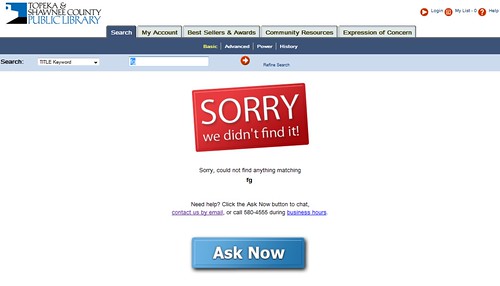
And we’re doing a few different things with the catalog embed, too. Here’s a pic of the keyword, No Records Found search:

New version of the Chat Reference service in the catalog

We’re trying to make instructions clear, friendly and attractive. If you click the Ask Now button, you get a tiny IM widget pop-up page. Why pop-up? With our Meebo widget, we discovered that a lot of people would start asking a question, then click something … and they’d be gone, because they had clicked away from the page with the embedded IM widget. Bumer! With our new pop-up version, that problem is solved. Users can click away all they want … and still interact with us.

But even cooler than that – Michael, our web designer (one of his many hats) discovered a way to embed a similar thing on the Search Results page:

Search Results page - Chat added!

This provides more opportunities for patrons to ask questions when they get stuck on a search – even if they’re finding things. Basically, they have access to us ON EVERY SEARCH they do.

And not just IM access – that’s provided via the Ask Now button. But we also include our phone number and a link to our email Ask a Librarian form.

We’re excited about this – should be fun to see if we get more catalog-related questions.

{ 11 comments }

Facebook Catalog App

by David Lee King on March 27, 2009

app on my profileMy way cool web team recently built a Facebook app for our library catalog! If you’re interested in trying it out, simply search for tscpl catalog in Facebook and our app will appear.

Not necessarily a new thing (do an app search in Facebook for library catalog and you’ll find quite a few) … but very useful, nonetheless.

Why haven’t we built an iPhone app like the DC Public Library? Our big goal is to focus on our local community, and build for them. I’m guessing that DCPL has quite a few iPhone users already (or at least potential library users that are also iPhone owners). Topeka? Not so much. I’ve been watching our web stats – last month, we had 63 iphone visits … about .18% of our total web visits. Not enough to design for (yet).

But Facebook use in Topeka? Judging by a quick walkthrough of our building (and peeking at what patrons are doing) – huge.

More Facebook app screenshots:

Enjoy!

{ 1 comment }

23 Things Summit notes

by David Lee King on March 3, 2009

Today, I participated in the 23 Things Summit, a webinar focused on exploring and improving Learning 2.0/23 Things programs put on by Webjunction, MaintainIT, TechSoup, and Topeka & Shawnee County Public Library. For my tiny part of the summit, I interviewed Helene Blowers and Michael Sauers. Here are notes on other people I listened to:

Twitter hashtag – #23smt

I interviewed Helene Blowers – here are my questions:

  • The concept of a Learning 2.0 or a 23 Things program originated with you, I believe. Can you share where this idea came from? Why did you start it? What was going on?
  • How did you start the program? Was it considered employee training? Did everyone at the library have to participate? Was there some impetus from admin to go through the program?
  • You did the first one – How did it go for your library?
  • If you could go back and do it differently, what would you change and why?
  • Was there any resistance with staff, lower or upper level?
  • It’s now global – how did it start taking off? Where is it now?

Jen Maney

They did 13 things – put them on a wiki

ended up doing a program for the whole state of arizona

2 goals:

  1. encourage exploration of 2.0 tools
  2. provide staff with new tools to better support the role of libraries as places of discovery

3 rules:

  1. give yourself permission to play
  2. make time for discovery
  3. have fun!

what we did right: included things relevant to area libraries, like online gaming, digital downloads – nice.

cool outcomes included: connections between people, rural library participation, early and late beginners, people did it at home, dial up didn’t stop them!, empowerment, not just for young people anymore!

Needed more communication!

Needed more local facilitation, have “a buddy” to help them

more incentives

13% completion rate – numbers weren’t the goal – people are still working on it

Ann Walker Smalley, Ruth Solie

From Minnesota

used blog as delivery method – 23thingsonastick.blogspot.com

tried to avoid things that were downloadable because of public lbirary policies

wow – some libraries actually unblocked things that were blocked just for this program – very cool

1600 registered participants! Wow. 600 finished, 38% finish rate. They received a USB flash drive. Nice.

********

Next up, me interviewing Michael Sauers

He presented, then I asked two questions:

  • How do you set up getting CE Credits for this? Great idea
  • Has anything come of your program yet, like new services, new blogs, etc?

**********

Bobbi Newman

Missouri River Regional Library – first in the USA to do this after Charlotte’s original program

added MySpace because MySpace was getting bad press, but users were using it so they wanted staff to be familiar with it

Their program ran a full year

Lifelong learning was important

(sorry, I missed stuff here! My bad)

**************

Shirley Biladeau

[aside - our twitter hashtag, #23smt, has trended - it's #9 right now]

Their program info is here

They encouraged library directors to encourage their staff. Nice.

**************

Q & A

Facilitated by Stephanie Gerding

Q: How do you get buy-in? How to sell this to management? How do you champion the concept of 2.0 to a 1.0 team?

A: Jen – it takes time. Admin has to hear about this stuff more than once.

Q: How do you encourage play?

A: Have peers do the coaching/mentoring

Q: How much time per week is needed for this program?

A: One hour

A: Michael – the answer is: it varies widely person to person. Some people spent 15 minutes, some spent 6 hours, etc.

A: Bobbi – they originally thought 2 hours a week, but participants told them they needed much more time than that

Q: For those running the program – how much time?

A: Bobbi – round 1 took a lot of time! At night, on her own time… Round 2 – comments were left on the official blog rather than on everyone’s blogs

A: Jen had a student working 20 hours a week on this

Q: incentives

A: Michael – used donations

A: Vendors

A: Certificate of completion, mp3 players

A: library association funds!

A: CE certificate credit

A: Bobbi – their team paid for completion gifts out of their own pocket because they believed in it so much – cool

Q: How did you measure participation and completion?

A: spreadsheet – someone used Google spreadsheet

A: Used SurveyMonkey to do a survey about what got answered

Q: DId you use an online community or CMS?

A: Ning, Drupal, wetpaint, Blogger, etc – a variety

Q: Replicating?

A: school librarians DID participate, but had to do it from home because most of the tools used were blocked

Q: did small libraries participate?

A: yes – many one-person-staff libraries did

Q: How did it change your styles as coordinator?

A: converted people to the “go play with it” style

A: remember that people learn in many different styles

Q: Has anyone done a 23 things styled program for patrons?

A: great idea

A: Metronet in MN is doing one with highschool students

Q: How do you deal with people who say they don’t have time?

A: Michael – make it continuous, flexible

A: no time is good for everyone, so provide options

A: make it relevant to their lives

Q: Did anyone use Second Life as a thing to learn?

A: No…

A: Michael mentioned that SL has an extra download component, and many sites can’t or don’t want to install extra software…

Q: Impact on community

A: help patrons with the tools they’re using

A: Bobbi – Outreach tools

I missed a lot! Thankfully, the archive is here.

{ 4 comments }

Watching Local News go Viral

by David Lee King on February 23, 2009

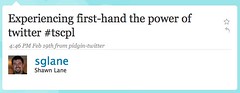
screenshot of twitter reactionWe live in a new world. A world in which local decisions made by very small groups can go viral, can be spread by a variety of social media tools, and can even reach global and unintended audiences. We are no longer private or anonymous! I watched just this thing unfold last Thursday at my library’s Board of Trustees meeting.

We Went Viral

By now, some of you have probably heard about the decision my library’s Board of Trustees made last Thursday regarding restricting access to four books in our collection. By the end of the evening, our very local library board meeting was the 7th hottest “trend” in Twitter.

I had decided to tweet the board meeting – I posted play-by-play public comments made by people in the community and the deliberations of the board on a hot topic. I used #tscpl as a hashtag, since I wanted to provide an easy way for people to follow the meeting as it progressed.

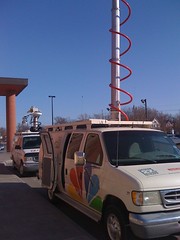
Camera Crews Getting Set UpAnd I started tweeting. I took photos of the local TV news vehicles lined up outside the library and a few pics of the meeting, and posted them to Twitter via the TwitPic service (a service that lets you easily share photos on Twitter). Jim Ogle, general manager at a local TV station (and cool tweep at @jimogle), was also present and tweeting at the meeting, as were a few other Twitter users.

Who followed the conversation? Local Topekans who weren’t at the meeting were following. Library staff that worked the evening shift were following along, too. Since I have my tweets linked to my Facebook status, Facebook friends were also following and participating by making comments and asking questions. Other librarians were following the meeting, as well.

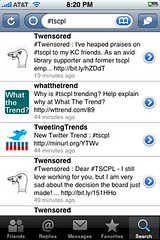
In other news, I trended in twitterAt some point in the evening, our hashtag, #tscpl,”trended” on Twitter. What’s trending? “Trending topics on Twitter are keywords that happen to be popping up in a whole bunch of tweets. We measure these topics and adjust them in real-time throughout the day. It’s a great way of finding out what’s happening right now.” – from Twitter’s blog.

And like I said, we were the 7th hottest trend for a while – sure wish I had a screenshot of that! The screenshot I DID get is from my iPhone, capturing some Twitter Trend-watching services that noticed our hashtag was trending.

We Went Global

The next day, the conversation continued, and it went global. People continued tweeting about the meeting and the decision, and I posted news stories as I found them. An AP reporter was at the Thursday meeting, so we made the AP newswire… and we quickly made the USAToday, the International Herald Tribune, and the Taipei Times, of all places. And of course the usual library-related news sites noticed.

Some unintended but interesting sites: two adult industry news sites (found via twitter searches for tscpl and topeka), some book industry news sites, and a children’s rights group. With some of these, I’m guessing they follow a combination of keyword searches and RSS feeds – they primarily picked up the AP story.

The conversation on those sites is continuing, since many of them allow comments on each article! It’s actually quite interesting to compare the local comments on the Topeka newspaper story to the comments on the USAToday story (98 comments so far).

We’re No Longer Private

What’s this all mean? That Twitter works great as a real-time information spreader and conversation starter. That people are interested even in seemingly local stuff. That … yes … even your small library board meeting is no longer private.

The WORLD is watching.

{ 10 comments }

Jenny Levine, ALA

1850s – libraries in Britain – pool halls in libraries, 1880s early chess club in a library

2005 or so – entering Eighth Age of librarianship – a participatory age.

Redefining what we mean by reading (Second Life avatar reading a book, avatars listening to someone else read a book in SL)

Gaming has been in the library (1850s) longer than KIDS have been in the library!

“stare at the screen all day” – it’s not passive – it’s active, and two-way

“he just sits there all day long…” – balance is the issue – shouldn’t read all day, play sports all day, game all day – gaming is not the problem – balance is

What would happen if video games would have been invented before books? – books are tragically isolating… no interaction, etc (Steven Johnson quote)

“aren’t social” – video games are actually very social.

“they already play videogames at home” (Eli Neiberger) – well, why do we do storytime at the library, if you can read at home? The library adds value to it… same thing with the library and gaming. We’re one of the last non-commercial facilities out there!

“Gaming is too loud…” Our libraries are loud, too!

“Libraries are about books” – and crocheting, and music, and etc etc etc – not just books anymore

“violent video games” – 85% of games are rated for everybody

Numbers – define gaming: any type of game. Summer reading is the biggest game in the library!

Who’s a gamer? Everyone pretty much – average age of gamer – 35 – middle-aged women are the largest demographic of gamers

talking about teaching a college-level statistics course for athletes – using Madden Fantasy Football

Gaming is a social experience for teens – gamers tend to be more civically engaged than non-gamers.

Games as readers advisory (from Beth Galloway): if you like to play Halo, here’s what you might enjoy reading…

Some libraries are offering Senior Spaces that have gaming as an introduction to technology. They use the Wii or the XBox, teens show the seniors how, then the seniors move to computer tech from there.

{ 13 comments }

Speaker – Thomas Frey, Senior Futurist at the DaVinci Institute

Planning the future is all about epiphanies – Frey is describing an epiphany he had

He used Shazam on his iPhone to figure out what song was playing in a restaurant, then was able to download the song right then. It was a transaction that happened right where he was at

Then he thought about the camera on his iPhone… why can’t you point your phone at something you want, take a pic of it, and buy it? Talking about the future of retail

Someone walking by – if you like his manbag, you can point and click your camera at it, then buy one for yourself

Showing pictures of different innovative library buildings

Now showing pics of Jay Walker’s private library

Showing pics of futuristic, robotic vending machines

another question – what music do we listen to now that we sill still be listening to in 100 years? The more important question is HOW will we be listening to it?

Talking about a variety of “ultimate future things” like vending machines, music players, drink dispensers, etc.

System thinking – what systems are we using today that are the equivalent of roman numerals and are holding us back?

Also technologies – roman numerals were a technology

Older vs newer synthesizer/piano keyboards (not sure I agree with him here, but I get the point)

slide rule

discussing the time between the end of an era and the beginning of a new one – lots of chaos lives there!

what’s in this era that’s going away? Fax, paper checks, keyboards, computer monitors, computer hardware, TV, sign language, invasive surgery, etc…

The end of wires! Yay. telephone, cable tv, internet, power… Frey thinks we’ll see wireless power within our lifetime

Evolution of Books: in what year will the last printed book be published?

Gutenberg press… showing the development of the printing press… Expresso Book Machine…

Amazon Kindle – it’s possible that within 5 years, something like this will cost about $20. Will libraries start handing out these things?

Books might become conversation – much more active… we ultimately don’t know

10 Global Trends

  1. 2007 more people lived in urban areas than rural areas
  2. more people cross country borders – more mobile
  3. more new product launches
  4. 2007 – over 550,000 new businesses being created in the US
  5. 2005 – more women reported being single – over 50%
  6. people working through and past retirement – more than doubled
  7. minorities will become the majority in 2042
  8. smaller families, bigger houses
  9. coming boom in data centers – youtube adds 50,000 clips or more to its library every week, etc…
  10. most educated country in the world is shifting – right now, it’s Canada

question – how long before you can get a PhD without being literate?

however you get the info into your head really shouldn’t matter – ebook, audio book, etc are all good

Socrates – never wrote anything.

Future of Education

they did an 18-month study

transition from teaching to learning… teaching requires experts.

Open Education Movement. Example – MIT videos all courses, you can you can take them for free

Wikiversity, Moodle, Curriki – similar idea

Learning drivers – what’s the most important thing students need to learn today?

12 dimensions of the future courseware architecture

modally agnostic, language agnostic… courses from everywhere, managed online

smart profiler & recommendation engine – finds what the person’s most interested in, etc

truch and accuracy – most of what’s being taught is theoretical

certification inputs… how much learning/classes do you need to do this job

official record-keeping system…

Basically more personal control, less control by institutions and teachers

Libraries will become the working laboratories for the creation of innovative new courses in this new, more independent education model

Starbucks. Commodit level is buying your coffee anywhere

Starbucks focuses on the experience level

New relevancy test – sorta like google’s pagerank, but in real life. People determine how relevant something is (ie., a library)

Library building – important still

8 recommendations of the library of the future

  1. create a search command center – people come because they’re searching for information. Help people conduct searches. Thinks future search attributes will include things like smell and taste. Why don’t we have search for the physical world?
  2. remote office space – [aside - how does that work with the physical library as important?] – Empire of One (one-person, highly outsourced, business). Cloud computing. “business colonies” – groups of people coming together for a project (like how movies are made now). Frey says the heart of every business colony will be the library. Hmm…
  3. production studios. people now want to help create information… have a blogging station. podcast studios.
  4. band practice studios.
  5. entertainment studios… gaming. Virtual world stations. mini theaters. exercise areas!
  6. The Expert Series. many people feel uncomfortable with new & changing tech.
  7. Time Capsule Room – archiving the history of the community. let the public decide what it should be… maybe local companies will want their history archived…
  8. poetry park. a public park that allows community members add inscriptions… “electronic outposts” (sort of a digital branch library). Libraries need to extend their influence so we’re always in front of the community…

Libraries need to become Epiphany centers for their communities.

{ 3 comments }